
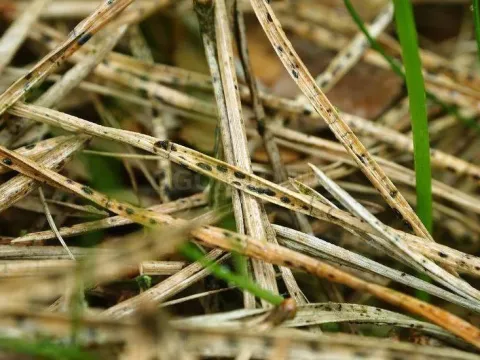
Rhizosphaera needle cast
Rhizosphaera kalkhoffii
The causal agent of this disease is the fungus Rhizosphaera kalkhoffii. This pathogen is a well-known threat to various conifer species, particularly in urban landscapes and nurseries.
What the section contains
Rhizosphaera needle cast
The fungus produces fruiting bodies known as pycnidia. These tiny structures develop within the stomata of the needles, which is a distinctive characteristic of the pathogen's life cycle.
Spores are spread via water splash, such as heavy rain or overhead irrigation, and wind. The infection cycle is closely linked to moisture levels, which trigger spore dispersal.
Spruce trees, especially the Colorado blue spruce (Picea pungens), are highly susceptible to this infection. Other conifer species may also be affected under favorable environmental conditions.
The fungus survives on infected needles on the tree or on the ground. It colonizes the needle tissue through the stomata, eventually killing the needles and causing them to drop prematurely.
The primary symptom is the discoloration of needles on older branches. Infected needles typically turn from green to a dull yellow, and later to a reddish-brown or purple-brown color.
A key diagnostic feature is the presence of small, black fruiting bodies (pycnidia) arranged in neat rows on the undersides of the needles. A magnifying glass is often needed to see them clearly.
Premature needle cast is common, usually starting from the bottom of the canopy and progressing upward. This often leaves the lower branches looking sparse or completely bare over time.
A notable trait of Rhizosphaera is that it primarily affects the older needles, while the newest growth at the tips of the twigs often remains green and healthy for the current season.
- Yellowing and browning of older needles.
- Black fungal fruiting bodies in rows on needle undersides.
- Premature needle shedding and bare branches.
- General decline in the tree's health and density.
The disease thrives in environments with high humidity and frequent rainfall. Prolonged periods of damp weather provide the perfect conditions for the spores to germinate and infect new needles.
Poor air circulation significantly increases the risk of an outbreak. Dense plantings or trees with thick, unpruned canopies are much more likely to harbor and spread the fungal spores.
Trees under stress, such as those suffering from drought, poor nutrition, or incorrect soil conditions, are significantly more vulnerable to colonization by Rhizosphaera.
Temperature plays a crucial role, with moderate temperatures (between 15°C and 22°C) promoting the most aggressive fungal activity and development of the disease.
The presence of infested needles on the ground creates a constant source of inoculum. If these are not removed, the fungus will continue to infect the tree during every wet season.
The reduction of the photosynthetic surface area leads to a decrease in the tree's energy reserves. This slows down the growth rate and weakens the overall structure of the spruce.
The aesthetic damage is severe, as the tree loses its characteristic dense foliage. Bare branches and discolored needles significantly lower the ornamental value of the landscape specimen.
Chronic infection weakens the tree over several years, making it susceptible to secondary stressors like bark beetles or opportunistic pests that can quickly finish off the tree.
If left untreated, the cumulative effect of annual needle loss can eventually lead to the death of entire branches and, in many cases, the total death of the specimen.
In a commercial setting, infected nursery stock becomes unmarketable due to poor appearance and the risk of spreading the disease to other nursery plants.
Sanitation is the first line of defense. Rake and dispose of all fallen needles from under the tree to minimize the source of fungal spores that could reinfect the tree.
Improve air circulation around the tree by thinning the canopy and pruning lower, heavily infected branches. Ensure proper spacing when planting new trees to prevent future outbreaks.
Chemical control involves the use of copper-based fungicides. Timing is critical; applications should begin when the new needles are half-elongated and repeated as recommended by the label.
For more severe cases, systemic fungicides from the strobilurin or triazole classes can be used to inhibit the fungus from within the plant tissues more effectively.
Ensure the trees are well-watered and receive proper fertilization to strengthen their natural defenses. A healthy tree is always more capable of resisting fungal invasions.