
Rhodonia
Rhodonia
The fungus Rhodonia placenta (syn. Postia placenta) is a significant wood-decaying organism classified as a brown rot fungus.
What the section contains
Rhodonia
It is specialized in the decomposition of structural polysaccharides in wood, specifically cellulose and hemicellulose, while leaving the lignin mostly intact.
The fungus propagates through the production of basidiospores that are dispersed by wind and water, allowing it to colonize new substrates effectively.
As a saprotrophic organism, it thrives in dead wood, but it also acts as a serious parasite, attacking the heartwood and sapwood of living coniferous and deciduous trees.
Its mycelium penetrates the wood cells by secreting specific enzymes, which allows it to thrive even in highly acidic environments within the decaying timber.
The most visible symptom of an infestation is brown cubical rot, where the wood cracks into small, brittle cubes along its structural grain.
The infected wood typically turns a characteristic reddish-brown or yellowish-brown color as the cellulose is removed, leaving the darker lignin behind.
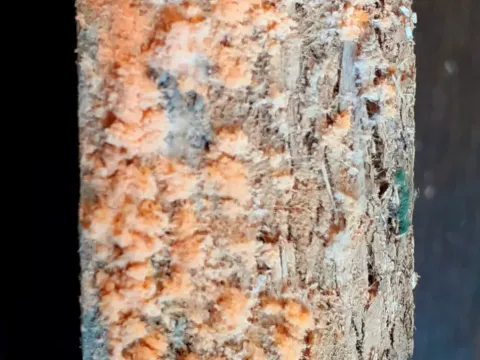
On the surface of the wood, one might observe white or yellowish, felt-like mycelial mats, often accompanied by rhizomorph-like structures in deep cracks.
Fruiting bodies (sporocarps) of Rhodonia are often soft, watery, and exhibit colors ranging from white to bright orange or pinkish hues.
Structural failure is a major sign; trees affected by the fungus often exhibit a lack of rigidity, making them highly susceptible to snapping or uprooting during storms.
Rhodonia requires a moisture content in the wood of at least 30% to 40% to initiate and maintain active decay cycles within the substrate.
Optimal development occurs in temperate climates, with temperatures typically ranging between 20°C and 25°C, though the mycelium can withstand some fluctuations.
Poorly ventilated areas, such as shaded forest floors or poorly stored timber stacks, provide the high-humidity environment necessary for spore germination.
Mechanical damage to trees, such as storm-induced wounds, frost cracks, or insect damage, provides convenient entry points for the fungal spores.
Accumulated debris and fallen branches serve as primary reservoirs, allowing the fungus to persist in the environment over many years.
The economic impact of Rhodonia is substantial in the forestry and construction sectors, as it rapidly degrades the structural integrity of timber.
For forestry, the decay leads to severe volume loss and timber quality reduction, making the trees harvested useless for standard construction purposes.
It also poses a safety risk, as infected trees in forests or parks can become hazards to people and property due to their sudden failure.
The presence of the fungus in building materials can lead to catastrophic failure of wooden beams, posts, and flooring if moisture levels are not strictly managed.
The spread of the fungus can also alter forest composition by selectively killing susceptible tree species, potentially impacting overall ecosystem biodiversity.
Effective management begins with strict sanitation practices, such as the removal of decaying wood and stumps that harbor the pathogen.
Proper timber storage is critical: wood should be kept dry, elevated from the ground, and stored in well-ventilated conditions to keep moisture levels low.
For structural timber, the application of chemical preservatives or borate treatments can provide an effective barrier against fungal colonization.
Monitoring programs that include regular inspections of high-value trees or structures are essential for early detection and containment of the infection.
- Sanitary removal of infected woody debris
- Maintaining dry storage for lumber
- Chemical preservation of wood structures
- Early detection and monitoring