
Resupinatus
Resupinatus
The fungus genus Resupinatus belongs to the group of wood-decaying fungi, functioning primarily as saprotrophs. They are members of the Pleurotaceae family, often mistaken for pathogens due to their close association with plant residues.
What the section contains
Resupinatus
The pathogen produces fruiting bodies with a characteristic resupinate (effused) form, adhering tightly to the substrate. The primary habitat is the wood debris of deciduous and coniferous tree species.
The fungal mycelium penetrates deep into the tissue structure, performing enzymatic decomposition of complex organic compounds. This is not a classic disease of living plants, but a degradation process of dead or severely weakened organic matter.
The biology of the species is studied mainly within forest mycology, where it is classified as a white rot agent. Fungal spores spread through air currents and settle on suitable substrates under high humidity.
Morphologically, the fruiting bodies often have a gelatinous consistency and a grayish or whitish hue. It is essential to distinguish them from true parasitic pathogens that infect healthy agricultural crops.
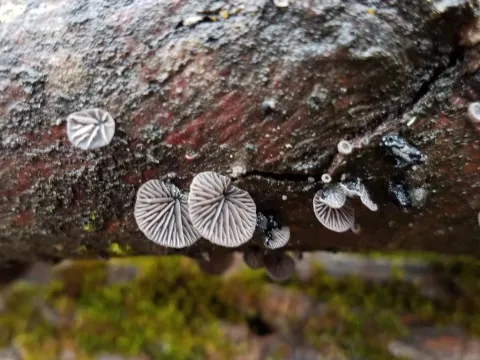
The main external sign of the fungus's presence is the appearance of small, effused cup-shaped structures on the wood surface. The fruiting bodies often grow in clusters, covering the substrate in a thick layer.
The tissue of the affected wood gradually loses its structural integrity and becomes bleached. This is directly linked to the intensive destruction of lignin, typical of xylotrophic fungal activity.
In field conditions, traces of activity are found on stumps, dry branches, or wood waste. The fungus is rarely found on healthy agricultural crops, appearing only in areas of significant mechanical injury.
Upon close inspection, one can see a hymenial layer with gills that may be arranged radially or randomly. The texture of the fruiting bodies remains elastic even during partial dehydration.
The absence of necrosis in the surrounding healthy tissues allows for clear differentiation of this species from dangerous bacterial infections or pathogenic fungal diseases.
Successful development of Resupinatus requires high relative humidity and constant moisture of the substrate itself. The fungus prefers shaded areas protected from direct sunlight.
The optimal temperature range is typical for forest ecosystems. In intensive farming, such conditions are found in old orchards or shelterbelts.
The presence of large amounts of organic debris and dead wood is a key factor for territorial colonization. Field sanitation and the removal of wood waste limit fungal spread.
Stagnant water in the soil or near tree roots creates a microclimate conducive to spore germination. Proper aeration and timely cleaning reduce the risk of fungal presence.
Prolonged moisture on damaged bark provides an entry point for the fungus to establish itself in a nutrient-rich environment.
Resupinatus does not pose a direct threat to the yield of field or vegetable crops. Unlike true parasites, it does not attack living tissues that possess a fully functional immune system.
The main harm lies in the gradual degradation of woody debris, which can weaken old trees in shelterbelts. This leads to the slow collapse of protective plantings.
In agroforestry, the presence of colonies on stumps can serve as an infection reservoir, although the fungus rarely transitions to cultivated plants. It is rather an indicator of poor site management.
Biomass accumulation on woody residues can alter soil pH in the development zone, indirectly affecting nutrient availability for plants.
Economic damage is minimal if agronomic practices include regular field sanitation and the removal of woody debris.
The most effective control method is the sanitary cleaning of the area from dead wood. Removing stumps and branch residues eliminates the nutrient base required by the fungus.
Maintaining the health of trees in orchards prevents the occurrence of wounds through which the fungus could penetrate the tissues. Pruning should be accompanied by mandatory disinfection of cut sites.
Chemical control against Resupinatus in industrial scales is practically never applied as it is not an economically viable measure.
Fungicide application is appropriate only within integrated protection programs for trees against wood-decaying pathogens. The choice of the agent depends on specific target organisms.
Timely management of excess moisture on the site helps naturally reduce the population of xylotrophic fungi, including members of the Resupinatus genus.