
Rhabdocline needle cast
Rhabdocline weirii
Description
Symptoms
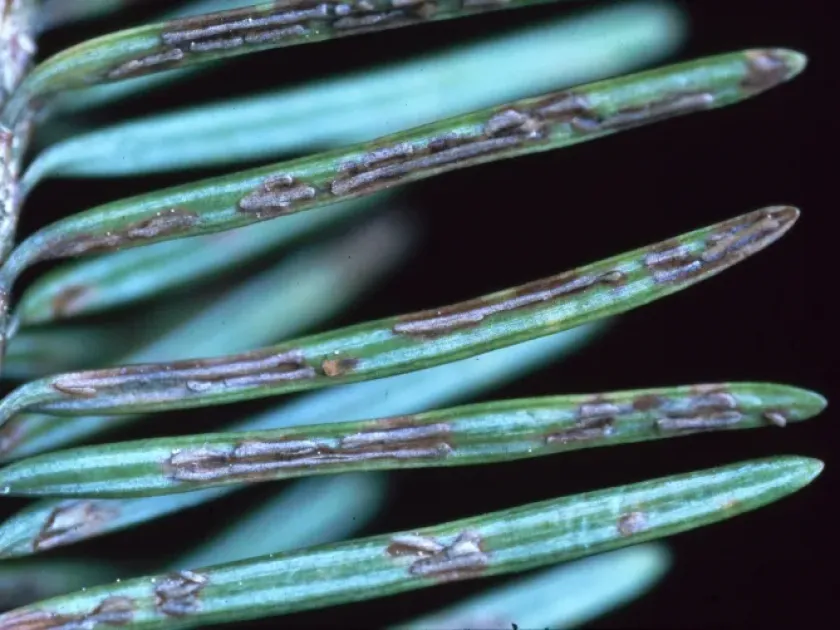
Early symptoms include the appearance of chlorotic (yellowish) spots or bands on the needles. Over time, these spots darken and turn into reddish-brown necrotic areas.
A distinctive feature of this infection is the presence of brown, elongated fruiting bodies visible on the underside of the needles, usually aligned parallel to the central midrib.
Heavy infections lead to significant needle casting, where foliage drops prematurely, leaving branches looking thin and sparse, especially in the inner parts of the crown.
While the disease often affects previous year's needles, in severe cases, the fungus can also colonize current-year foliage, leading to a rapid decline in the tree's health.
- Yellowish-brown spots or bands on needles.
- Characteristic brown fruiting bodies on the underside of needles.
- Premature needle drop and thinning crowns.
- Stunted shoot growth in severe cases.
- General loss of tree vigor and aesthetic value.
Pathogen
The disease is caused by the fungus Rhabdocline weirii, an ascomycete that specifically infects members of the genus Pseudotsuga (Douglas firs). It is a highly specialized pathogen that has evolved to parasitize these specific hosts.
The fungus produces fruiting bodies known as apothecia, which appear as elongated, slightly raised yellow-brown or orange cushions that erupt through the needle's epidermis.
These fruiting bodies mature and release spores primarily during moist spring weather. The spores are then dispersed by wind and rain splashes to new, susceptible needles on the same or neighboring trees.
The pathogen overwinters within infected needles, either those still attached to the branches or those that have fallen to the ground, serving as a primary inoculum source.
The biological cycle of Rhabdocline is strictly synchronized with the bud burst and shoot elongation of Douglas firs, ensuring that the fungus targets the most susceptible young tissues.
Conditions for development
Prolonged wet and rainy weather conditions during the spring are critical for the successful infection of needles. Water droplets are necessary for spores to germinate and penetrate the host tissue.
Dense, overcrowded planting sites restrict air circulation, which keeps the foliage damp for longer periods. This high humidity creates the optimal environment for the proliferation of Rhabdocline fungi.
Temperatures ranging from 15°C to 20°C are optimal for spore germination and mycelial development within the plant tissues, leading to rapid disease progression.
Proximity to infected trees or areas with a high accumulation of infected needle litter increases the probability of new infections due to a high concentration of airborne spores.
Trees under physiological stress, such as drought or poor nutrient availability, show increased susceptibility to the disease compared to vigorous, well-maintained trees.
Why it matters
Rhabdocline needle cast is particularly devastating in nurseries, where it can cause high mortality among young seedlings, making them unsuitable for outplanting.
In mature stands, chronic infection leads to significant reduction in the tree's photosynthetic capacity, which directly results in lower wood production and loss of increment.
Constant defoliation weakens the host's immune system, making the trees more vulnerable to secondary infestation by bark beetles and other wood-boring insects.
From an aesthetic perspective, the disease significantly devalues Christmas trees and ornamental Douglas firs, as the thin, spotted, and dropping foliage is highly undesirable.
Economic losses include not only the potential loss of timber volume but also the high costs associated with repeated fungicide applications and site sanitation measures.
Protection
Sanitation is a primary control strategy. Removing and destroying fallen infected needles helps to reduce the primary inoculum load and slows down the spread of the disease.
Fungicidal applications are most effective when timed with the early stages of bud break and needle expansion. Copper-based or systemic fungicides are typically recommended for professional use.
Cultural practices such as pruning lower branches and ensuring adequate spacing between trees promote better air circulation and leaf drying, which helps to mitigate disease pressure.
Monitoring is crucial for early detection. Detecting the first sign of apothecia allows for targeted interventions before the fungus can spread across the entire plantation.
Planting resistant provenances or hybrids of Douglas fir is the most sustainable approach, effectively eliminating or significantly reducing the need for chemical intervention in the long run.
Discussion
No discussions yet — be the first.