
Reticulate leaf gall
Exobasidium reticulatum
Description
Symptoms
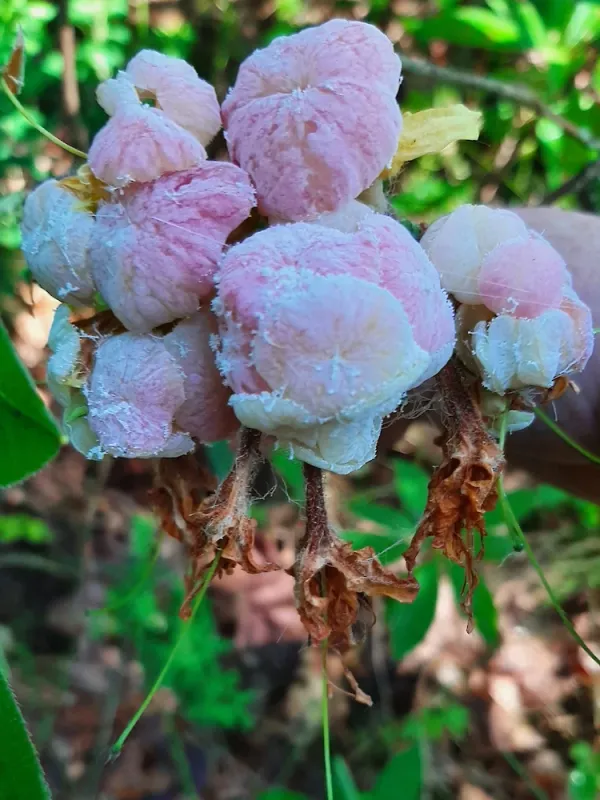
The primary symptom of the disease is the appearance of specific growths on leaves, manifesting as yellowish-green or reddish spots that eventually develop a reticulate pattern. In the affected areas, the leaf blade often deforms, becoming raised, convex, or wrinkled.
On the underside of the leaf within the affected zone, a characteristic white or grayish powdery coating forms, which represents the pathogen's sporulation. As the disease progresses, the spots expand, covering a significant portion of the leaf surface.
Affected leaves often turn yellow prematurely, lose their ability to perform normal photosynthesis, and drop earlier than natural senescence would dictate. In severe cases, young shoots are also affected, becoming deformed and covered in a spore layer.
Visually, the disease is easily distinguished from other spots by the net-like structure of the affected tissue and the specific whitish coating. Symptoms typically develop during the period of active spring growth when new leaves are forming.
The appearance of the shrub becomes stunted when heavily infected; decorative value is lost, and without proper treatment, the plant weakens significantly and may eventually perish.
Pathogen
The disease is caused by the microscopic fungus Exobasidium reticulatum, which belongs to the basidiomycetes. This pathogen is a highly specialized parasite that primarily affects plants of the Ericaceae family.
The fungus develops directly within the tissues of the host plant, penetrating the epidermis and intercellular spaces of the leaves. Its life cycle is closely linked to the seasonal rhythms of the plant's development and environmental humidity changes.
The white coating on the underside of the leaf is a layer of basidia with spores, which are dispersed by wind or rain splashes. Spores are capable of surviving in plant debris and soil for long periods, awaiting favorable conditions to germinate.
The pathogen activates its growth processes during spring when temperatures become optimal for mycelium development. The infection can spread over considerable distances under high humidity conditions.
The biology of Exobasidium reticulatum involves a prolonged latent period within tissues until massive spore production occurs, making early detection and control challenging.
Conditions for development
The development of reticulate leaf gall is favored by periods of prolonged rainfall, high humidity, and moderate temperatures. These environmental conditions create an ideal environment for spore germination and infection of plant tissues.
Dense plantings with poor air circulation create a microclimate with high humidity levels, which significantly accelerates the spread of the fungal infection. Poor ventilation prevents foliage from drying quickly after rain or dew.
The disease occurs more frequently in areas with poor drainage where moisture stagnates in the root zone. High soil moisture combined with humid air is a key factor triggering pathogen activity.
Weakened plants, suffering from nutrient deficiencies or stress due to poor agricultural practices, are most susceptible to infection. Tissue damage caused by late spring frosts also provides entry points for fungal spores.
Optimal conditions for infection often coincide with the phase of young leaf unfolding, as these tissues are highly sensitive to the impact of Exobasidium reticulatum.
Why it matters
The primary damage lies in the sharp decline of the plant's decorative appeal, rendering them unsuitable for landscaping. Severe infection can lead to complete defoliation of the shrub by mid-summer.
The impairment of photosynthesis due to tissue deformity and necrosis weakens the plant's immune system. Consequently, the shrubs become more susceptible to secondary infections and pest attacks, accelerating their decline.
If infection occurs annually, the plant becomes exhausted, stops producing flower buds, and fails to bloom. This significantly reduces the economic value of nursery stock and garden specimens.
On young seedlings, the fungus can cause shoot deformation, leading to distorted crown shapes and the loss of varietal characteristics. In nurseries, this can result in mass culling of plant material.
Gradual leaf and branch dieback can lead to the death of the entire plant if measures to combat the fungal pathogen are not taken in time.
Protection
The primary control measure is the removal and immediate burning of all infected plant parts. It is essential not to leave fallen leaves under shrubs, as they act as a major source of spore dispersal.
The use of copper-based fungicides (such as Bordeaux mixture) before the start of the growing season is effective in reducing the infection pressure. Applications should be performed thoroughly, covering the entire crown.
An important element of prevention is following good agricultural practices: proper watering at the base, avoiding overhead irrigation of leaves, and ensuring optimal planting density. Promoting good air circulation significantly reduces infection risk.
During active growth, the use of systemic fungicides with preventative and curative action against basidiomycete fungi is recommended. Alternating between different products helps prevent the development of resistance in the pathogen.
- Thinning out plantings to improve airflow.
- Collecting and destroying plant debris.
- Regular monitoring of shrub condition in spring.
- Implementing preventative fungicide applications.
- Selecting resistant varieties when planting new specimens.
Discussion
No discussions yet — be the first.