
Rhabdocline needle cast
Rhabdocline pseudotsugae
Description
Symptoms
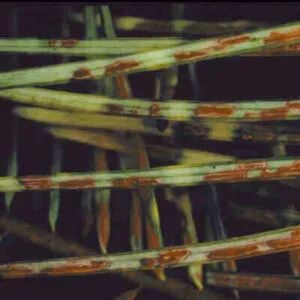
Early symptoms appear as yellow spots on the needles, which eventually transition into reddish-brown or purple-brown bands.
The presence of elongated, tan or orange-colored apothecia on the lower surface of the needles is a definitive diagnostic feature.
Severely infected needles often exhibit chlorosis before turning brown and premature shedding occurs during mid-summer.
Infection typically starts in the lower canopy where high humidity persists for longer periods compared to the upper crown.
Affected trees often look sparse and discolored, particularly during the transition between late spring and early summer.
Pathogen
The disease is caused by the ascomycete fungus Rhabdocline pseudotsugae, which is highly specific to the Douglas fir species.
The pathogen completes its life cycle by infecting needles of various ages, though it primarily targets the previous year's foliage.
The fungus develops fruiting bodies called apothecia directly beneath the epidermal layer of the needle surface.
These fruiting bodies rupture the needle cuticle, releasing ascospores into the environment during wet conditions.
The mycelium grows intercellularly within the needle parenchyma, eventually causing the death of the photosynthetic tissues.
Conditions for development
The development of this disease is heavily dependent on prolonged periods of moisture during the spring months.
High humidity and moderate temperatures favor spore germination and the infection of newly emerging needle tissues.
Dense planting schemes that limit airflow and trap moisture create an environment conducive to rapid pathogen spread.
Rain splash is a primary mechanism for the dispersal of ascospores from infected needles to healthy foliage nearby.
Trees that are already stressed by poor site conditions or nutrient deficiencies are more prone to severe infections.
Why it matters
Rhabdocline needle cast can cause severe defoliation, which negatively impacts the overall health and vigor of Douglas fir trees.
In nursery settings, the disease causes significant economic loss by rendering seedlings unsalable due to poor appearance.
Reduced photosynthetic capacity from needle loss results in stunted growth and weakened resistance to other environmental stressors.
Repeated annual infections can lead to branch dieback and, in extreme cases, the mortality of young or vulnerable trees.
The aesthetic value of trees used in landscaping and Christmas tree production is greatly diminished by the presence of this fungus.
Protection
Selecting resistant varieties of Douglas fir is the most effective long-term strategy for preventing needle cast outbreaks.
Proper site selection and wide spacing between trees are crucial to improve air circulation and reduce humidity within the canopy.
Sanitation practices, such as removing and destroying fallen infected needles, can reduce the amount of inoculum present.
Applying registered fungicides during the period of new needle emergence is effective if weather conditions are conducive to infection.
Regular monitoring of tree health during the spring allows for timely intervention before the disease becomes widespread.
Discussion
No discussions yet — be the first.