
Description
Symptoms
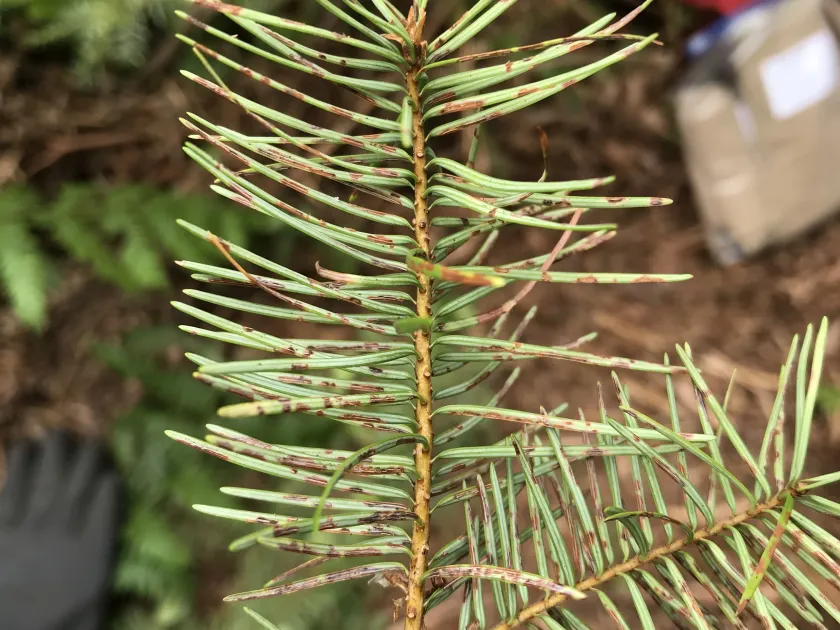
Early symptoms appear in the spring as yellow to light green spots on needles that were infected during the previous year.
As the season progresses, these spots expand into characteristic reddish-brown or purple-brown patches, giving the foliage a mottled appearance.
The most diagnostic sign is the presence of elongated, raised brown ridges on the underside of the needles, which are the fungal fruiting structures.
Heavily infected needles turn completely brown or red and are shed prematurely, usually by mid-summer, leaving branches sparse.
The lower and inner parts of the canopy typically show the most severe symptoms due to prolonged moisture and reduced airflow.
Pathogen
Rhabdocline needle cast is caused by fungal pathogens from the genus Rhabdocline, specifically targeting members of the Pseudotsuga genus, notably Douglas fir.
The fungus is an ascomycete that colonizes the internal tissues of the needles, completing its life cycle by developing fruiting bodies under the needle epidermis.
These fruiting bodies, known as apothecia, eventually rupture the epidermis, creating visible lines that facilitate spore dispersal.
The disease cycle is synchronized with the tree's growth; spores are released primarily in the spring when new foliage is most susceptible to infection.
The fungus persists on needles attached to the tree and, to a lesser extent, in the litter, maintaining a reservoir for subsequent infections.
Conditions for development
Extended periods of cool, wet, and humid weather during the spring are ideal for the germination of fungal spores on new needles.
Dense stand architecture that prevents rapid drying of the canopy promotes the development and spread of the disease.
Trees that are under physiological stress due to improper site conditions or lack of nutrients are significantly more susceptible to severe infection.
High spore density in the surrounding environment, often due to existing infected Douglas firs, dramatically increases local infection rates.
The absence of adequate sunlight, which helps dry the foliage, allows the fungus to thrive and colonize new tissue more effectively.
Why it matters
The primary impact of the disease is the loss of photosynthetic capacity due to premature needle abscission, which weakens the entire tree.
Repeated annual infections can lead to severe stunting, growth loss, and, in young trees, mortality due to cumulative stress.
The aesthetic value of the tree is severely compromised, making it unsuitable for landscape use or Christmas tree production.
Infected trees become less resilient to other environmental stressors, including drought, insect attacks, and secondary pathogens.
Economic losses in nurseries and plantations can be substantial, requiring intensive and often costly management strategies.
Protection
The most effective strategy is the selection of resistant cultivars or seed sources that show natural tolerance to the fungus.
Proper site selection and spacing are critical to ensure good air circulation and rapid drying of the canopy, which hinders spore germination.
Sanitation measures, such as removing and destroying heavily infected needles and twigs, help reduce the local inoculum load.
Chemical control using systemic fungicides or copper-based sprays can be effective if applied during the critical infection window in spring.
- Implement strict quarantine practices when introducing new stock.
- Monitor plantations closely during the spring bud-break stage.
- Maintain tree vigor through appropriate fertilization and water management.
Pathogens and affected parts
Affects crops · 1
Discussion
No discussions yet — be the first.