
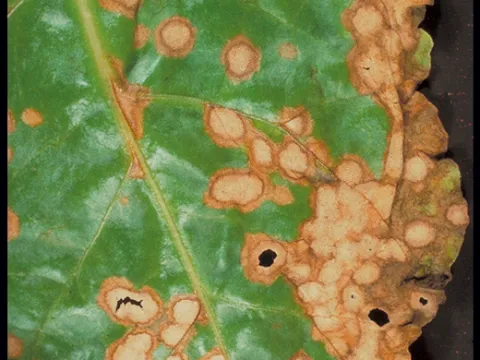
Ramularia leaf spot of knotweed
Ramularia polygoni
The disease is caused by the imperfect fungus Ramularia polygoni, which belongs to the class Hyphomycetes and primarily infects species of the Polygonaceae family.
What the section contains
Ramularia leaf spot of knotweed
The pathogen propagates through conidia, which are asexual spores that spread the infection throughout the plant population during the growing season.
The fungus colonizes the intercellular spaces within the host tissue, eventually rupturing the epidermis to produce conidiophores for further spore dissemination.
The pathogen survives the winter as chlamydospores or dormant mycelium within infested plant debris or soil, serving as a primary source of inoculum.
Spore transmission occurs primarily via wind currents, splashing rain droplets, or physical contact during routine agricultural maintenance tasks.
Symptoms typically manifest as necrotic lesions on the leaves, which are initially small and pale, later becoming brownish or greyish in color.
These spots often exhibit a characteristic dark border and may vary in shape from circular to irregular depending on the extent of tissue colonization.
Under high humidity conditions, a sparse, whitish fungal growth can be observed on the underside of the leaves, indicating active conidial production.
In cases of severe infection, individual lesions may coalesce, leading to extensive necrosis, yellowing of the leaf tissue, and premature defoliation.
The pathogen can also affect stems and petioles, resulting in elongated lesions that can impair the translocation of water and nutrients within the plant.
Ramularia polygoni thrives in conditions characterized by high relative humidity, frequent rainfall, and mild to moderate temperatures.
Dense plant stands with poor airflow and prolonged leaf wetness duration provide a perfect environment for rapid fungal establishment and spread.
Temperature plays a crucial role in disease development, with the fungus showing optimal activity in the range of +18°C to +24°C.
High plant density coupled with poor drainage significantly increases the microclimate humidity, accelerating the disease progression cycle.
Environmental stressors that weaken the plant's health can make it more susceptible to opportunistic colonization by this fungal pathogen.
The primary damage caused by this disease is the reduction of the plant's photosynthetic surface area, which leads to decreased vigor and growth rates.
For crops cultivated for herbal or medicinal use, infection significantly lowers the yield and the concentration of secondary plant metabolites.
Premature leaf drop caused by the disease reduces the total biomass produced, impacting the overall productivity of the crop plantation.
The weakened state of infected plants makes them more vulnerable to secondary infections or secondary pest infestations, further damaging crop quality.
Widespread occurrence of the pathogen in a field leads to significant economic loss and complicates subsequent production cycles due to soil contamination.
Management strategies include rigorous sanitation practices, such as the removal and destruction of all infected plant residues to reduce the inoculum load.
Crop rotation should be implemented, avoiding the cultivation of susceptible Polygonaceae species in the same field for several consecutive seasons.
Fungicide applications, particularly those containing copper or systemic active ingredients, can be used to control the disease during the peak growing phase.
Ensuring optimal plant spacing and proper weeding is essential to promote airflow and decrease the humidity levels around the foliage.
- Regular monitoring and scouting of the crop for early symptoms.
- Implementation of balanced fertilization to support host plant resilience.
- Selection of disease-resistant varieties if available in the market.