
Ramularia leaf spot of potato
Ramularia eudidyma
The causal agent of Ramularia leaf spot in potatoes is the fungus Ramularia eudidyma, a deuteromycete that primarily impacts foliage health.
What the section contains
Ramularia leaf spot of potato
The pathogen survives in crop debris within the soil, serving as a primary source of inoculum for subsequent planting seasons.
Conidia, the fungal spores, are easily disseminated by wind, water splashes, and contaminated agricultural tools throughout the field.
The fungus invades the leaf tissues, colonizing the intercellular spaces and disrupting the plant's physiological functions and nutrient absorption.
It can also persist on various weed species of the Solanaceae family, acting as an alternative host that sustains the fungal population.
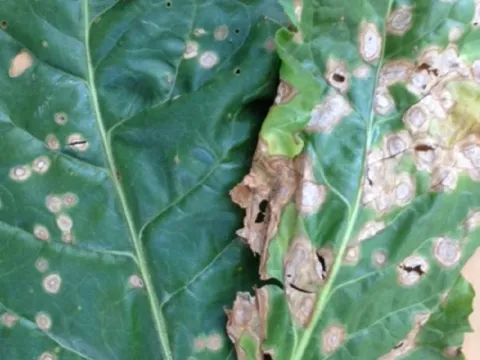
Symptoms initially manifest as small, angular spots on the lower leaves, often displaying a brownish or dark gray coloration.
As the disease progresses, the lesions become clearly delimited by leaf veins, resulting in a distinct, mosaic-like, or netted appearance.
Under conditions of high humidity, a characteristic whitish or grayish mold appears on the underside of the leaves, indicating spore production.
Affected tissues undergo necrosis, leading to yellowing, premature drying, and the eventual abscission of the leaves, which significantly reduces leaf area.
Unlike late blight, the lesions of Ramularia remain relatively small and localized, rarely showing the rapid spread typical of larger blights.
The development of Ramularia leaf spot is favored by cool to moderate temperatures ranging from 15°C to 22°C and high atmospheric humidity.
Persistent dew, frequent rain, or heavy fog provide the necessary moisture on the leaf surface for the conidia to germinate and infect the tissue.
Dense canopies that restrict air movement increase the risk of infection by maintaining a humid microclimate within the potato foliage.
Plants that are stressed due to nutrient imbalances or mechanical damage are observed to be more susceptible to successful colonization by the fungus.
A history of short-term crop rotation increases the likelihood of high inoculum density in the soil, raising the risk of early-season outbreaks.
The primary economic damage is caused by the reduction in photosynthetic capacity, which directly translates to lower tuber yield and smaller tuber size.
Premature leaf senescence cuts short the period of tuber bulking, often preventing the crop from reaching its maximum genetic yield potential.
Severe infestations can cause significant crop losses, particularly when favorable weather conditions persist for an extended period during the growing season.
Weakened foliage is more prone to subsequent secondary infections and potential storage issues that negatively impact post-harvest quality.
The necessity for additional fungicide applications adds significant operational costs to the potato production cycle.
Effective management requires an integrated approach that focuses on reducing the initial inoculum and slowing down the rate of disease spread.
Cultural practices such as long-term crop rotation and proper sanitation, including the destruction of crop residues, are fundamental to disease prevention.
Monitoring fields closely during the mid-season allows for timely intervention if the disease thresholds are exceeded.
Chemical control involving systemic fungicides, particularly those containing triazoles, is effective when applied preventatively or upon early detection.
- Use certified, disease-free seed potatoes.
- Practice a 3-4 year crop rotation cycle.
- Control weeds, especially Solanaceous species, near fields.
- Manage canopy density to ensure adequate ventilation.
- Apply fungicides based on regional weather models.