
Ramularia leaf spot of horseradish
Ramularia armoraciae
The causative agent of this disease is the fungus Ramularia armoraciae. It is a specialized pathogen that primarily targets plants within the Brassicaceae family, particularly horseradish.
What the section contains
Ramularia leaf spot of horseradish
The fungus survives the winter as mycelium or sclerotia within infected plant debris remaining in the soil. In spring, when conditions become favorable, it produces conidia that initiate new infections.
Dissemination occurs via wind, splashing rain, or insect vectors, which move the spores onto healthy leaves. High humidity is a critical factor for spore germination and successful host colonization.
Once inside the leaf tissue through stomata or wounds, the fungal mycelium grows intercellularly, absorbing nutrients and causing the characteristic lesions associated with the infection.
The fungus is capable of completing multiple infection cycles within a single growing season, which allows the disease to spread rapidly across fields if weather conditions are right.
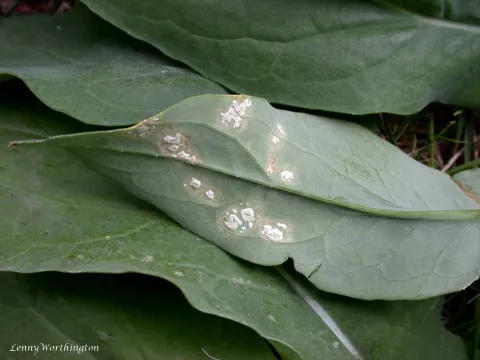
The first symptoms appear as small, irregular or angular spots on the leaves. Initially, these spots are light green to yellow, but they gradually turn brown or gray as the infection progresses.
As the disease advances, the spots often increase in size and can coalesce, leading to significant chlorosis and necrosis of the leaf area. A light-colored halo may form around the lesions.
On the underside of the leaves, corresponding to the necrotic spots, a white or grayish powdery growth develops. This represents the fungal sporulation, consisting of conidiophores and conidia.
Severely infected leaves become brittle, curl, and eventually dry out. This leads to premature defoliation, which significantly reduces the plant's photosynthetic capacity.
- Development of small angular leaf spots with gray centers.
- White powdery sporulation visible on the leaf underside.
- Premature yellowing and drying of the foliage.
- Overall loss of vigor and stunted development of the plant.
The disease thrives in cool, moist environments. Temperatures between 15°C and 20°C (59-68°F) combined with high air humidity are optimal for fungal growth.
Frequent rainfall, heavy dew, or persistent fog creates a conducive environment for spore germination and penetration of the host tissue, leading to rapid disease development.
Dense planting configurations limit air circulation, keeping the foliage wet for longer periods and creating microclimates that favor the development of Ramularia armoraciae.
Poor field hygiene, such as leaving weed debris or old horseradish leaves on the ground, provides the fungus with the necessary substrate for overwintering and early spring activation.
Stress factors, such as improper fertilization or drought, can weaken the horseradish plants, making them more susceptible to colonization by the pathogen.
The primary impact of Ramularia leaf spot is the reduction of the leaf surface area. As the leaves die prematurely, the plant's ability to produce sugars for root storage is severely compromised.
This results in smaller root sizes and poor quality of the harvested horseradish. Roots may lack the expected pungency and culinary value, leading to economic losses for commercial growers.
Weakened plants are more prone to secondary infections from other pathogens, including various types of soft rots that can affect the roots during storage.
Significant infestations can reduce total yields by up to 50% in bad years. Furthermore, the aesthetic value of the horseradish leaves (if harvested for specialty uses) is entirely destroyed.
In addition to yield loss, the cost of fungicides and extra labor for disease management significantly increases the overall production budget for the grower.
Implementing a robust crop rotation plan is essential. Horseradish should not be planted in the same soil for at least three to four years to break the pathogen's life cycle.
Sanitation is critical. All plant debris should be removed and destroyed or buried deeply after harvest to eliminate the primary sources of overwintering inoculum.
Fungicides can be applied as a preventive or curative measure upon the first signs of the disease. It is important to select products labeled for horseradish and rotate modes of action.
Proper spacing during planting is vital to ensure adequate air circulation, which helps keep the leaf surface dry and discourages fungal spore germination.
Ensure the use of healthy, disease-free planting material (root cuttings) obtained from reputable sources to avoid introducing the fungus into clean fields.