
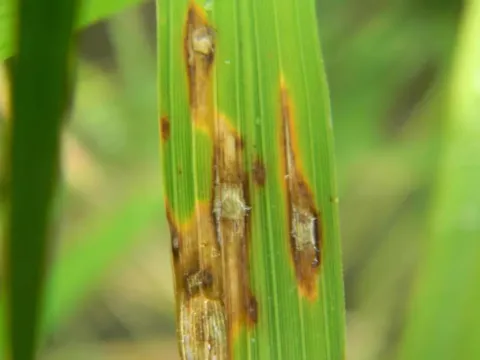
Rice blast
Pyricularia
The first symptoms of the disease appear as small, elliptical, or spindle-shaped lesions on leaves, stems, and nodes. Initially, these spots exhibit a grayish-green color surrounded by a distinct dark brown border.
What the section contains
Rice blast
As the disease progresses, the lesions enlarge, developing a whitish-gray center. In conditions of high humidity, an olive-gray velvety layer consisting of fungal conidia forms on the infected areas.
Severe infection of the stem nodes leads to their blackening and breakage, frequently causing "white-head" or sterile panicles. The plant becomes fragile, leading to crop lodging and significant yield losses.
On panicles, the infection manifests as dark spots that can spread to the grains, causing them to shrink and change color. Infected seeds often have poor germination and serve as a primary source of infection for subsequent seasons.
Hidden forms of fungal development, where symptoms are not visible until the pathogen reaches a critical stage, pose a particular danger, often complicating timely diagnostic and control efforts.
The causative agent of the disease is the imperfect fungus Pyricularia oryzae (synonym Magnaporthe oryzae), a member of the Ascomycota class. It is a highly specialized pathogen primarily affecting cereal crops.
The fungus reproduces via conidia, which are dispersed by wind, raindrops, and irrigation water over significant distances. These conidia are highly capable of germinating if a thin film of moisture exists on the plant surface.
Inside the plant tissues, the fungus forms mycelium that penetrates epidermal cells, releasing toxins. These substances disrupt plant metabolic processes, suppressing the immune system and facilitating further spread of the infection.
The pathogen overwinters as mycelium and conidia on crop residues, in the soil, and on seeds. This ability to remain viable under unfavorable conditions ensures the pathogen's high survival rate within crop rotations.
The aggressiveness of the pathogen is constantly evolving due to the emergence of new races capable of overcoming the resistance of existing crop varieties, necessitating continuous monitoring of phytosanitary status.
Epidemics of rice blast are favored by prolonged periods of high humidity exceeding 90%. The presence of free moisture is a critical prerequisite for the successful germination of fungal spores.
The optimal temperature range for active pathogen development is between +25 and +28 degrees Celsius. Under these conditions, the infection cycle shortens, allowing the fungus to produce several generations in a short period.
Imbalanced application of nitrogen fertilizers, specifically excessive levels, stimulates vigorous vegetative growth and reduces the plant's natural resistance to the penetration of fungal mycelium.
Dense crop stands create a specific microclimate in the lower canopy where air stagnates and humidity remains high. Such conditions significantly accelerate the speed of disease spread within the agro-ecosystem.
Violation of crop rotation and continuous cultivation of susceptible varieties in the same field lead to the accumulation of inoculum in the soil, making the risk of a disease outbreak extremely high.
Rice blast is considered one of the most destructive diseases of rice worldwide, capable of causing yield losses ranging from 50% to 100% under favorable conditions. The losses affect both grain quantity and quality.
Massive infection of leaves leads to premature necrosis and a sharp decline in photosynthetic efficiency. This deprives the plant of the energy needed for the formation of fully developed reproductive organs.
Stem infection causes mechanical damage, leading to lodging, which complicates mechanized harvesting. As a result, combine harvesters fail to collect the entire biomass, increasing harvest losses.
A reduction in thousand-grain weight and grain shriveling lead to a sharp decline in technological quality. The grain loses its market value, becomes brittle, and is unsuitable for long-term storage or processing.
Economic consequences of epidemics include not only direct yield losses but also high costs for expensive fungicides and expenditures for mandatory disinfection of seeds and soils.
The primary method of control is the use of blast-resistant varieties. Genetic resistance allows for a significant reduction in disease intensity, even under challenging environmental conditions.
Agronomic measures include adhering to proper crop rotations, deep plowing to incorporate crop residues, and controlling weeds that may act as reservoirs for the pathogen during the off-season.
Optimizing mineral nutrition, particularly limiting excess nitrogen and applying potassium, enhances plant tissue resistance to pathogen penetration. It is also important to maintain appropriate seeding rates to ensure canopy ventilation.
Chemical protection involves the timely application of fungicides, such as triazoles and strobilurins. Treatments should be applied preventively or upon the first signs of disease incidence in the field.
Seed dressing before planting is a critical step, allowing for the disinfection of planting material and protecting young seedlings from early infection, thereby ensuring uniform and healthy crop establishment.