
Rice false smut
Ustilaginoidea
Description
Symptoms
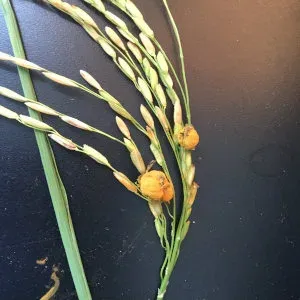
Initial symptoms become visible only during the ripening phase, when large fungal structures replace healthy grains within the glumes.
Externally, the symptom manifests as spherical growths that are initially yellowish or orange, eventually turning velvety green or nearly black.
These fungal clumps can significantly exceed the size of a healthy rice kernel, leading to the spreading of panicle glumes and deformation of the spikelet.
Upon maturity, the fungal spores are easily released, creating a powdery olive-colored deposit on neighboring plants and panicle organs.
- Presence of velvety green spores on the grains.
- Significant increase in the size of infected grains.
- Deformation and partial destruction of the panicle.
- Infection of individual spikelets within the same panicle.
Pathogen
The disease is caused by the fungus Ustilaginoidea virens, which belongs to the class of Ascomycetes. During its life cycle, the pathogen forms specific sclerotia that allow it to overwinter in the soil as mycelium.
The infection targets rice exclusively, infiltrating the plant during the flowering stage. The critical window for infection occurs during panicle emergence when fungal spores land on the pistils.
The pathogen's biology is characterized by the formation of large olive-green pseudosclerotia that gradually replace the grain kernels. These structures serve as sources of secondary infection throughout the growing season.
The fungus maintains viability in the soil and on crop debris for several years, making it highly resilient against adverse environmental conditions.
Mycological studies confirm that the pathogen actively produces toxins, such as ustilaginoidins, which reduce grain quality and pose safety risks for agricultural products.
Conditions for development
The most favorable conditions for infection development include high relative humidity levels, consistently exceeding 90% during the crop's flowering period.
A temperature range from +25°C to +30°C is considered optimal for conidia germination and the rapid spread of the pathogen throughout the fields.
Prolonged rainfall and overcast weather during the panicle emergence phase drastically increase the risk of massive disease outbreaks in rice paddies.
Agronomic factors, such as high planting density and excessive nitrogen fertilization, create a microclimate that promotes rapid fungal growth.
Disease development is closely linked to the flowering period, so any irrigation scheduling that increases humidity during this critical phase triggers outbreaks.
Why it matters
Direct damage results in a substantial yield loss, as the fungus entirely replaces the endosperm of the kernel with its mycelial tissues.
Infected grain becomes unsuitable for human consumption and industrial processing, leading to significant economic losses for rice producers.
The toxicity of the spores and fungal metabolic products renders the produce unsafe, severely limiting market opportunities for the harvested crop.
Infected fields require extra costs for grain cleaning, as spores are extremely difficult to separate fully from healthy fractions during post-harvest processing.
Seed quality declines: planting material sourced from infected fields exhibits low germination rates and poor vigor, making it unsuitable for sowing.
Protection
The cornerstone of protection is the use of certified, healthy seed material free from Ustilaginoidea virens spores.
It is essential to practice crop rotation and perform deep plowing to bury crop residues where the pathogen's sclerotia survive.
During the rice flowering period, the application of systemic fungicides is recommended if weather conditions favor the development of the disease.
Balanced nitrogen fertilization helps prevent excessive vegetative growth, thereby reducing plant density and microclimate humidity.
Timely removal of grass weeds, which can serve as secondary reservoirs for the infection during the off-season, is highly necessary.
Discussion
No discussions yet — be the first.