
Rice false smut
Ustilaginoidea virens
Description
Symptoms
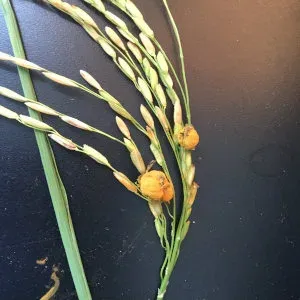
The most distinctive symptom is the appearance of velvety spore balls on individual grains within the panicle. These balls are initially yellow or orange but turn olive-green or black as they mature.
Infected florets often swell and split open, revealing the powdery mass of chlamydospores. Typically, only a portion of the grains in a single panicle is affected, giving the cluster a variegated appearance.
Under humid conditions, a sticky exudate containing spores may appear on the surface of the fungal balls, which serves as a source for secondary infection throughout the field.
While the exterior is covered in dark spores, the interior of the pseudo-sclerotium remains a dense, pale structure. The presence of these grains during harvest is a primary indicator of disease prevalence.
Diagnosis is usually delayed until the grain-filling stage, as the signs become visible only as the rice reaches the dough stage, making early detection difficult for field scouts.
Pathogen
The disease is caused by the fungus Ustilaginoidea virens (anamorph Villosiclava virens), an ascomycete pathogen that specifically targets rice crops in warm and humid regions worldwide.
The life cycle begins with sclerotia, which overwinter in the soil or on crop debris. In spring, these germinate to produce stromata, releasing spores that are windborne or water-splashed onto susceptible rice panicles.
The fungus infects rice florets during the flowering stage. It colonizes the ovary, gradually replacing the grain tissues with its own mycelium and massive spore production.
This process results in the formation of large, velvet-like structures known as pseudo-sclerotia that take the place of healthy rice kernels. These structures eventually replace the entire grain.
Because the pathogen can persist in the soil for several years, long-term survival of the fungus poses a significant challenge for sustainable rice cultivation if field sanitation is neglected.
Conditions for development
Rice false smut thrives in high humidity conditions, typically above 80–90% relative humidity, especially during the flowering stage. Persistent rainfall and cloudy weather favor infection.
Optimal temperatures for pathogen development range between 25°C and 30°C. Hot and humid weather during the heading and flowering phases is critical for mass infection events.
Excessive application of nitrogen fertilizers leads to denser canopies and prolonged flowering periods, which creates a more favorable microclimate for the fungus to spread.
Improper plant spacing and high seeding density contribute to poor airflow, allowing moisture to remain trapped within the canopy and facilitating spore transmission between plants.
Poor soil drainage and stagnant water in the paddies can exacerbate the development of the pathogen by maintaining the high moisture levels required for spore germination.
Why it matters
The disease causes significant economic loss by directly reducing grain yield through the destruction of individual kernels. Infected grains are rendered completely unusable.
Beyond yield reduction, the disease severely compromises the quality of harvested grain. Contamination with spores changes the color and aroma of the rice, making it unsuitable for commercial processing.
The fungus produces toxins, such as ustiloxins, which are harmful to both humans and livestock. Consequently, grain lots heavily contaminated with false smut are often rejected for food or feed use.
Processing costs increase significantly as extra cleaning measures are required to remove infected grains and spores, further reducing the profit margins for farmers.
In severe cases, widespread infection can lead to substantial losses of up to 20–40% of the total harvest, negatively impacting regional food security and economic stability.
Protection
Using resistant rice cultivars is the most effective long-term strategy for managing false smut. Selecting genetically adapted varieties can drastically reduce infection risks.
Crop rotation is essential to break the pathogen's life cycle in the soil. Moving away from continuous rice monoculture helps lower the background levels of inoculum in the field.
Fungicide application during the panicle initiation or flowering stage is a critical intervention method. Timing is essential, and treatments should be based on local weather forecasts.
- Utilizing clean, disease-free, and certified seed sources.
- Deep plowing fields to bury crop debris and reduce primary inoculum.
- Balancing nitrogen inputs to prevent overly succulent and dense plant growth.
- Implementing effective drainage systems to manage field moisture.
- Monitoring and removing infected plants or weeds that act as alternative hosts.
Integrated pest management, combining chemical, cultural, and biological strategies, is the best approach to ensure stable yields and high grain quality in the face of this pathogen.
Discussion
No discussions yet — be the first.