
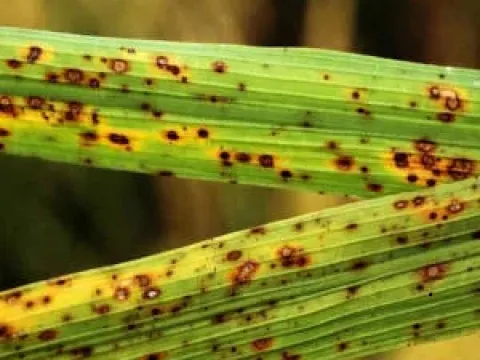
Rice brown spot
Bipolaris yamadae
The causal agent of this disease is the fungus Bipolaris yamadae (syn. Helminthosporium yamadae), a member of the imperfect fungi class. It produces dark, multicellular conidia which serve as the primary source of infection.
What the section contains
Rice brown spot
The pathogen is highly persistent, capable of surviving for long periods in soil, crop residues, and within rice seeds. Its life cycle is designed for rapid spread within rice ecosystems under favorable conditions.
Infection is primarily spread by wind-borne conidia that can travel over long distances. Overwintering occurs mainly in the form of mycelia or conidia on post-harvest stubble, making field sanitation a critical factor.
Bipolaris yamadae acts by secreting specific toxins that cause localized necrosis in rice tissues. These toxins disrupt the plant's metabolic processes and contribute to the visible lesion formation on the leaves and panicles.
Laboratory identification involves isolating the fungus on culture media and performing microscopic examinations to observe the characteristic dark, septate spores. This diagnostics is essential for effective disease management.
Initial symptoms manifest as small, brown, oval or elongated spots on the leaves. As the disease progresses, these lesions often enlarge and develop a yellowish or reddish-brown border, which is a diagnostic feature.
In severe cases, the spots coalesce, covering large areas of the leaf blade, which leads to premature wilting and tissue death. The disease also affects the leaf sheaths and stems, causing them to weaken and turn brown.
The most critical symptom occurs when the fungus attacks the panicles. The glumes become discolored and covered with a dark, velvet-like fungal growth, resulting in poor grain filling or total spikelet sterility.
Under humid conditions, the lesions exhibit an olive-black fuzzy appearance, which is the sporulating surface of the fungus. This visual indicator helps growers identify active infection centers in the field.
General plant stunting and reduced vegetative vigor are typical signs of chronic infestation. The weakened plant structure is often more susceptible to secondary pathogenic infections and environmental stress.
High humidity and moisture are the primary drivers of Bipolaris yamadae outbreaks. The pathogen thrives in environments where air humidity remains high, particularly during the boot and heading stages of the rice crop.
The optimal temperature range for conidial germination is between +20 and +28 degrees Celsius. Frequent rainfall, dew, and foggy weather significantly accelerate the spread of the disease.
Agronomic practices, such as excessive plant density, decrease air circulation within the canopy, creating a microclimate that remains damp for longer periods, thus favoring fungal colonization.
Nutrient deficiency, particularly a lack of potassium and phosphorus, compromises the rice plant's natural defense mechanisms. Malnourished plants show significantly higher vulnerability to fungal attacks.
Presence of alternative host plants, such as wild grasses in or near the field, provides a reservoir for the fungus to persist between seasons, ensuring a steady supply of inoculum for the next crop.
Rice brown spot is responsible for significant yield losses, which can range from 30% to 50% in severe, epidemic years. The disease drastically reduces both the quantity and quality of the final grain harvest.
Infested grains are often lightweight, shriveled, and discolored, which reduces their milling quality and market value. Such grain often fails to meet standard food processing requirements.
Infection leads to reduced seed germination rates and poor seedling vigor. This lack of uniformity in the field often necessitates costly replanting and increases the overall expenditure of the farming cycle.
Premature leaf death disrupts the plant's photosynthetic capacity, hindering the grain-filling process. This metabolic failure results in significantly lower test weights for the harvested rice grain.
Management costs represent a major economic burden, as farmers must invest in chemical control, frequent field inspections, and specialized processing equipment to remove damaged or discolored grains from the batch.
The cornerstone of management is the use of high-quality, certified seeds treated with effective fungicides. This reduces the primary inoculum transmitted by the seed itself.
Good agricultural practices are essential, including deep plowing to bury crop residues, which hastens the decomposition of infected straw and reduces the overwintering capacity of the fungus.
Cultivating resistant or tolerant rice varieties is the most sustainable approach to minimizing losses. Breeding programs focus on genetic traits that prevent the pathogen from colonizing host tissues.
Timely application of systemic fungicides during critical development phases can effectively curb the disease. Spraying should be based on real-time field monitoring and meteorological data.
- Seed treatment with systemic fungicides.
- Crop rotation to break the disease cycle.
- Balanced fertilization, emphasizing potash levels.
- Removal of weed hosts and volunteers.
- Scouting fields regularly during early growth stages.