
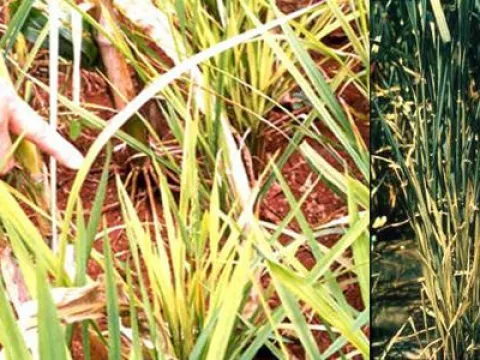
Rice bunchy stunt
Rice bunchy
The causal agent of the disease known as Rice bunchy stunt is a virus belonging to the phytoreovirus group. This is a systemic disease that affects the vascular system of the plant and disrupts its normal metabolism.
What the section contains
Rice bunchy stunt
The virus is transmitted by specific insect vectors, particularly leafhoppers. The virus is capable of replicating within the vector's body, ensuring that the infectious agent persists throughout the insect's lifespan.
Besides leafhoppers, the spread of the pathogen can occur through infected planting material during vegetative propagation in experimental settings. However, the primary mode of field transmission is entomological.
The disease primarily affects rice crops. The damage caused by the virus involves growth suppression and the inability to form a full-fledged grain head, leading to significant yield losses.
A biological feature of the pathogen is its high ability to persist in host tissues. Viral particles concentrate mainly in the phloem tissues, causing their deformation and systemic failure.
The main symptom of the disease is extreme tillering of the plants. Stems become short and numerous, forming a dense rosette that resembles a bunch of grass.
Leaves of infected plants often acquire a chlorotic hue, curl, and become brittle. Some varieties exhibit pronounced mottling or yellow stripes along the veins.
Growth retardation is a critical symptom. Infected plants lag behind healthy neighbors in development, often remaining stunted throughout the growing season.
The process of generative development is disrupted. Diseased plants either fail to produce panicles at all or form underdeveloped, sterile inflorescences that do not produce grain.
The root system also undergoes changes: it becomes less developed and weak, making the plants more susceptible to other abiotic and biotic stresses.
The development of the disease is closely linked to the activity of leafhopper vector populations. The highest incidence of the virus is observed in seasons with warm, humid weather, which facilitates the mass reproduction of insects.
Temperature plays a key role in the virus incubation period. Optimal values for active pathogen accumulation in plant tissues range from 25 to 30 degrees Celsius.
Agronomic factors, such as the failure to clear weeds along the edges of rice paddies, contribute to the accumulation of virus reservoirs. Weeds often serve as shelters for the vectors.
Dense rice stands facilitate the rapid spread of infection from diseased plants to healthy ones. The microclimate inside a dense canopy is ideal for the movement of leafhoppers.
Improper irrigation and fertilization regimes that weaken rice immunity make plants more vulnerable to primary infection upon contact with vectors.
Rice bunchy stunt poses a serious threat to rice-growing regions. Infected crops can lose up to 80–100% of their yield because such plants produce virtually no productive grain.
Economic losses are composed not only of direct production losses but also of the necessity to implement costly protection measures, as well as the potential loss of entire crop segments.
The spread of the disease may lead to the forced abandonment of fields if the level of infestation exceeds economic injury levels in the early stages of development.
The disease negatively affects grain quality, reducing its grade and marketability due to panicle failure and shriveled seeds.
The presence of the disease complicates breeding work, as the virus can strike breeding lines and collections, destroying years of meticulous effort by agronomists and plant breeders.
The primary method of control is managing the population of insect vectors. The application of systemic insecticides allows for the containment of virus spread during critical growth phases.
Prevention includes the use of healthy and disease-resistant seed material. Selecting locally adapted varieties is the foundation of defense against viral infections.
Agronomic protection measures include adhering to optimal planting times and maintaining field cleanliness by eliminating weeds that may act as virus reservoirs.
It is important to monitor the population of leafhoppers in rice fields using pheromone traps or visual observation. This allows for timely decisions regarding chemical treatments.
If infection clusters are detected, their localization by removing and destroying diseased plants is recommended to prevent further spread of the infection within the field.