
Dwarf leaf rust
Puccinia pygmaea
The causal agent of dwarf leaf rust is the fungus Puccinia pygmaea, a member of the Basidiomycota phylum. As an obligate biotroph, this pathogen relies entirely on living plant tissues to obtain nutrients, completing its life cycle by alternating between different hosts.
What the section contains
Dwarf leaf rust
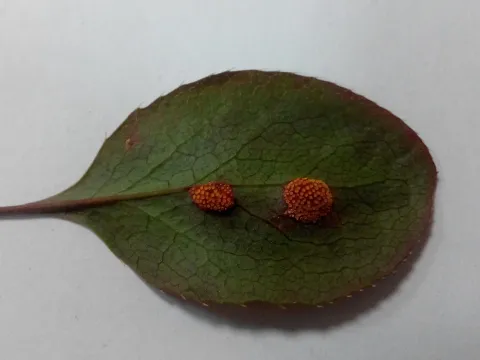
Common barberry (Berberis) serves as the primary alternate host for this fungus. During the spring, the pathogen produces aeciospores on the leaves of the barberry, which are then disseminated by wind to infect the target cereal crops.
Once on the cereals, the fungus progresses through its uredinial stage, characterized by rapid asexual reproduction. This cycle allows for secondary infections that can spread across large fields during a single growing season under favorable climate conditions.
Toward the end of the season, the fungus transitions to the telial stage, producing dark teliospores. These spores are specifically adapted for overwintering, allowing the pathogen to persist on crop debris or soil until the following spring, restarting the cycle.
Because of its ability to evolve and develop new pathogenic races, Puccinia pygmaea poses a persistent threat to cereal production. Ongoing monitoring and genetic research into plant resistance are essential for managing this destructive disease globally.
The primary symptom of dwarf leaf rust is the appearance of small, scattered, orange-brown pustules (uredinia) on the leaf blades. Unlike the larger, elongated pustules of stem rust, these are typically smaller and less structured in their distribution.
As the infection progresses, the leaves show signs of chlorosis, followed by necrosis. The photosynthetic efficiency of the plant is significantly impaired as the fungus consumes host nutrients, often leading to premature wilting and drying of the foliage.
In the late stages of infection, telia develop, appearing as dark brown or black, slightly raised lines, often covered by the epidermis. These structures serve as the overwintering mechanism and are usually found on the underside of the leaves or leaf sheaths.
Diagnostic identification is based on the specific morphology of the urediniospores and the appearance of the pustules on the host plant. A key indicator is the general stunted appearance of the infected crop, which often gives the disease its common name.
- Orange-colored uredinia scattered on leaf surfaces.
- Development of black telia at the end of the season.
- Premature yellowing and desiccation of leaves.
- Reduced plant height and general weakness in crop vigor.
Dwarf leaf rust development is highly dependent on moderate temperature ranges, specifically between 15°C and 22°C. These temperatures, combined with high humidity, create an environment where spores can germinate and infect plant tissues efficiently.
The presence of free moisture, such as dew or light rain, is a critical requirement for spore germination. Even brief periods of leaf wetness can lead to successful colonization by the fungal mycelium if spores are present on the leaf surface.
The proximity of infected barberry bushes is a major factor in the severity of local outbreaks. These bushes act as "green bridges," ensuring that an initial inoculum is available every spring to trigger the spread of rust to nearby grain fields.
Densely planted fields with poor ventilation provide an ideal microclimate for the fungus, as stagnant air retains humidity. This environment encourages the spread of spores from leaf to leaf, accelerating the progression of the disease.
High nitrogen fertilization, particularly when unbalanced with potassium, can create soft, succulent leaf tissue that is easier for the fungal hyphae to penetrate. Proper nutrient management is thus an essential part of disease prevention.
The primary damage caused by dwarf leaf rust is the reduction of the photosynthetic leaf area. This leads to a substantial decrease in the plant's ability to produce sugars, resulting in poor grain filling and significantly lower yields at harvest.
In forage crops, the disease reduces the nutritional value of the foliage. Infected plants have lower protein content and decreased digestibility, which directly impacts the quality and profitability of hay or silage used in livestock production.
Stressed, infected plants are significantly more susceptible to secondary pathogens, including root rots and various leaf spots. The increased water transpiration from pustule-damaged leaves makes crops less resilient to drought conditions during the critical grain-filling phase.
Economic losses during epidemic years can reach up to 40% of the total potential yield. Farmers must consider the costs of fungicide applications versus the projected losses, making early diagnosis crucial for maintaining field profitability.
Long-term exposure to the disease can shift the composition of pasture grasses toward less desirable or resistant, but less productive, plant species. This degrades the overall quality of the meadow and requires active management to restore productivity.
The most effective cultural strategy is the eradication of barberry bushes in the vicinity of cereal fields. By removing the alternate host, the pathogen's primary life cycle is disrupted, preventing early-season infection of grain crops.
Breeding and utilizing resistant cultivars is the gold standard for long-term rust management. Varieties with specific resistance genes can prevent the fungus from establishing, drastically reducing the need for chemical intervention.
Fungicide application is necessary when weather conditions favor disease spread and infection thresholds are met. Triazole and strobilurin-based fungicides provide effective systemic protection for the upper leaves, which are vital for crop yield.
Good agricultural practices, such as maintaining proper plant spacing to improve airflow and timely weed control, help reduce the local infection pressure. Tillage practices that bury crop residues can also help decrease the number of overwintering spores.
Integrated Pest Management (IPM) programs rely on continuous scouting and weather data analysis to predict infection risks. By combining genetic, cultural, and chemical controls, farmers can achieve robust protection against dwarf leaf rust.