
Early blight
Alternaria grandis
Description
Symptoms
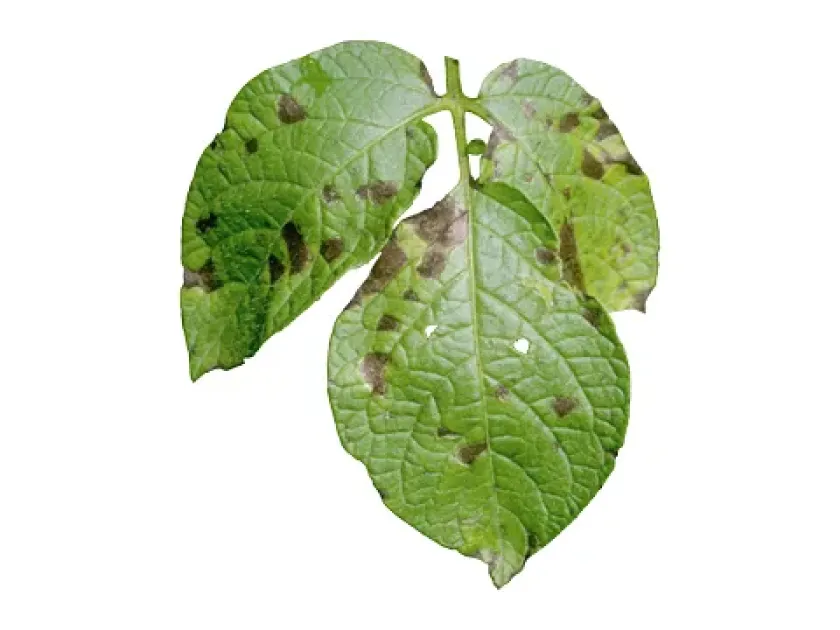
Early blight typically manifests as small, dark brown or black circular lesions on the lower, older leaves of the plant. A distinctive feature of these spots is the presence of concentric rings, giving them a target-like appearance.
As the infection progresses, these lesions expand and merge, causing extensive chlorosis and leaf necrosis. The loss of foliage significantly reduces the plant's photosynthetic capacity, which leads to stunted growth and lower yields.
Stems and petioles can also be affected, displaying elongated, dark-colored lesions. If these lesions girdle the stem, it can cause the entire upper portion of the plant to wilt and eventually die off due to vascular disruption.
Fruit infection often occurs at the point of attachment to the stem. The lesions appear as sunken, dark spots that eventually become covered with a velvety, black mass of spores, significantly lowering the marketability of the produce.
In potatoes, tubers can show dark, sunken, leathery spots. These infected areas can serve as entry points for secondary decay organisms during storage, leading to complete tuber breakdown if not managed properly.
Pathogen
The causal agent of this disease is the fungus Alternaria grandis. It is a resilient pathogen capable of surviving for long periods in soil, on infected plant debris, and occasionally on seeds or tubers.
The fungus produces conidia which are primary inocula disseminated by wind, splashing rain, and irrigation water. These spores can travel significant distances, allowing the disease to spread rapidly across fields.
Alternaria grandis is a facultative parasite, meaning it can survive on decaying organic matter in the absence of a host crop. This makes it a persistent threat in both open-field and greenhouse environments.
The host range is primarily limited to the Solanaceae family, including economically important crops like tomatoes, potatoes, eggplants, and peppers. The fungus typically attacks plants that are nearing maturity or are under environmental stress.
Its life cycle is perfectly adapted to agricultural systems where host crops are grown repeatedly. Without proper sanitation, the pathogen population in a field can increase steadily over successive growing seasons.
Conditions for development
Optimal growth for Alternaria grandis occurs in temperatures ranging from 20 to 30 degrees Celsius. In these favorable thermal conditions, the fungus can complete its infection cycle within just a few days.
High relative humidity and the presence of free water on leaf surfaces are essential for spore germination. Heavy dew, frequent rain showers, or overhead irrigation provide the moisture required for the pathogen to establish infection.
Dense planting patterns that restrict airflow create a favorable microclimate within the crop canopy. The reduced evaporation leads to prolonged periods of leaf wetness, drastically increasing the rate of infection.
Physical injuries caused by insect pests like aphids or beetles create entry points for the fungus. Similarly, mechanical damage during pruning or weeding can facilitate the penetration of mycelium into plant tissues.
Plants suffering from nutrient deficiencies, particularly nitrogen and potassium, are significantly more susceptible to infection. Maintaining optimal soil fertility is a crucial aspect of reducing overall crop vulnerability.
Why it matters
The economic impact of early blight is primarily due to premature leaf drop and the resulting yield losses. In severe cases, the defoliation can lead to substantial reductions in total harvestable weight for both potatoes and tomatoes.
Produce quality is severely degraded, especially in tomatoes, where fruit lesions make them unmarketable. Infected potatoes may not show immediate symptoms but can rot in storage, leading to significant financial losses for growers.
The disease requires intensive chemical management, which increases production costs. Repeated fungicide applications are often necessary, adding to the total expense and labor requirements of the farming operation.
Early blight can also negatively affect the quality of seeds and tubers saved for the next season. Infected planting material carries the pathogen to new fields, perpetuating the cycle of disease across the farm.
Large-scale outbreaks can lead to significant regional losses, impacting market prices and supply chains. Effective management is essential to stabilize productivity and ensure the sustainability of solanaceous crop production.
Protection
The most effective long-term control strategy is the implementation of a diverse crop rotation. Avoiding solanaceous crops on the same field for at least three years helps to break the pathogen's life cycle.
Sanitation is critical; all infected plant debris must be removed or plowed deep into the soil after harvest. This action removes the primary inoculum source that would otherwise overwinter in the field.
Fungicide programs should be started preventively if environmental conditions favor disease development. Copper-based fungicides and modern systemic agents are highly effective when applied before the disease becomes widespread.
- Use certified disease-free seeds and tubers.
- Maintain proper spacing to improve airflow.
- Control insect pests that damage plant tissues.
- Use drip irrigation to keep foliage dry.
In greenhouse settings, climate control is paramount. Maintaining low humidity through proper ventilation and avoiding overhead watering are simple yet highly effective ways to prevent early blight outbreaks.
Discussion
No discussions yet — be the first.