
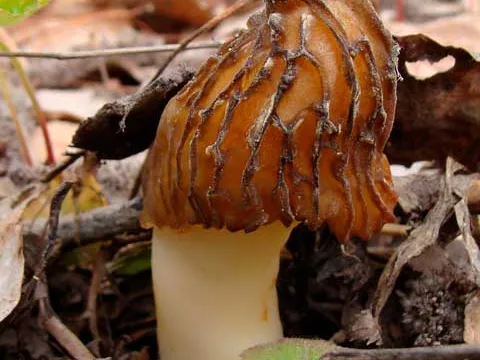
Early morel
Ptychoverpa
The early morel, scientifically known as Ptychoverpa bohemica, is an ascomycete fungus belonging to the Morchellaceae family. It is crucial to clarify that this organism is not a plant disease or a pathogen.
What the section contains
Early morel
In biological terms, it is a saprotrophic fungus. It feeds on decaying organic matter and plays a significant role in breaking down plant litter in forest ecosystems.
The mycelium resides in the upper soil layers, interacting with the environment to mineralize nutrients, but it never initiates parasitic relationships with living plants.
Confusion often arises when gardeners observe its rapid growth during spring, leading some to incorrectly label it as a crop pest or a disease.
Biologically, it is a beneficial decomposer that contributes to soil health, rather than an agent of plant infection or degradation.
The primary sign of its presence is the emergence of fruiting bodies during the early spring season, typically appearing after the snow melts.
The fungus features a distinct cap that is bell-shaped or conical, with a surface characterized by prominent, wrinkled, and brain-like longitudinal folds.
The cap color ranges from light yellowish-brown to dark brown, while the stem is typically long, cylindrical, white to cream-colored, and hollow.
It prefers moist, organic-rich environments such as deciduous forests, and its appearance is a reliable indicator of healthy, nutrient-rich soil conditions.
Finding these fungi in a garden environment is perfectly normal and does not represent a symptom of any plant health issues or pathological conditions.
Ptychoverpa bohemica thrives under specific cool and moist environmental conditions typical of the early spring period.
The optimal development of its fruiting bodies is triggered by high soil moisture levels and mild temperatures, generally ranging between 10°C and 18°C.
The fungus is highly dependent on a steady supply of organic matter, such as leaf litter, which provides the necessary nutrients for its mycelial growth.
It typically avoids environments with extreme soil acidity or drought, favoring areas where moisture is naturally retained by organic accumulation.
The development of this species is entirely independent of the physiological state of neighboring vascular plants, unlike obligate plant pathogens.
The early morel causes no harm to agricultural crops, ornamentals, or fruit trees as it lacks the machinery to penetrate or feed on living plant cells.
It does not secrete any phytotoxic substances, ensuring that the health and growth potential of your garden plants remain unaffected by its presence.
There is no economic damage associated with this fungus; therefore, it should never be included in pest or disease management programs.
The ecological role of the early morel is purely beneficial, as it facilitates the nutrient cycling process in the topsoil, helping to maintain soil fertility.
Concerns about this fungus causing crop loss are based on misconceptions, and there is no documented evidence of it harming agricultural production.
Since the early morel is not a plant disease, there are absolutely no control measures required to manage it in agricultural or home garden settings.
If the appearance of fruiting bodies is considered aesthetically undesirable, they can be removed manually without damaging the soil structure.
Regular soil cultivation and ensuring proper drainage can naturally limit the occurrence of saprotrophic fungi by reducing the accumulation of excess surface organic matter.
No chemical intervention, such as fungicide application, is recommended or effective, as it would only harm the beneficial soil biome.
The best management strategy is to recognize the organism as a harmless part of the natural garden ecosystem and focus efforts on managing true plant pathogens.