
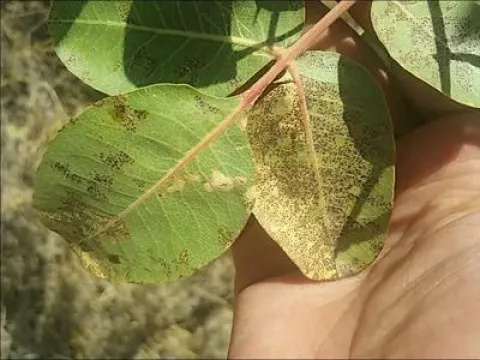
Pistachio pseudocercospora leaf spot
Pseudocercospora pistacina
The causative agent of this disease is the fungus Pseudocercospora pistacina. It is a specialized phytopathogen that exclusively targets Pistacia species.
What the section contains
Pistachio pseudocercospora leaf spot
The pathogen survives the winter primarily in infected leaf litter. As spring arrives, it produces spores that serve as the primary source of infection for new foliage.
Dissemination of conidia is effectively facilitated by wind currents and splashing rain, allowing the disease to spread rapidly across an entire orchard.
The fungus penetrates leaf tissue via stomata, colonizing the plant’s parenchyma and disrupting photosynthesis through the production of enzymes and toxins.
Understanding the life cycle of Pseudocercospora pistacina is essential for effective orchard disease management, as it can persist in the environment for multiple seasons.
The disease typically begins with the appearance of small, irregular yellow spots on the leaves. These spots gradually expand and transition to a brownish or grey hue.
Under conditions of high relative humidity, a characteristic olive-green or dark velvety layer develops on the underside of the leaves, representing the fungus's reproductive structures.
Affected leaves eventually wither and undergo premature senescence, leading to early defoliation which impacts the plant’s overall vigor.
If the infection is severe, it can extend to leaf stalks, causing necrosis and dieback of smaller twigs, particularly in younger trees.
- Yellowish spots on foliage during summer.
- Development of greyish necrotic centers on spots.
- Olive-colored fungal sporulation on leaf undersides.
- Premature leaf drop leading to canopy thinning.
- Dieback of petioles and young shoots.
Disease development is highly dependent on environmental moisture. Frequent rainfall, dew, and high atmospheric humidity are critical for spore germination and infection.
The optimal temperature range for the pathogen's growth is between 20°C and 28°C, which coincides with the active growth period of the pistachio tree.
Orchards with high density or poor air circulation are particularly prone to outbreaks, as they retain humidity for extended periods.
Inconsistent or warm winter periods can lead to earlier maturation of the fungus in plant debris, shifting the infection timing earlier in the spring season.
High nitrogen levels combined with excess irrigation can sometimes create lush growth that is more susceptible to rapid colonization by the pathogen.
The primary impact of the disease is the reduction of the functional leaf area, which significantly hampers the tree's ability to produce carbohydrates.
Premature leaf loss prevents proper bud development for the following season, often resulting in a biennial bearing pattern or permanent yield reduction.
Nut quality suffers significantly; affected nuts may be smaller, poorly filled, or have underdeveloped kernels, which reduces their overall market value.
Repeated annual outbreaks weaken the tree's immune system, making it more susceptible to opportunistic wood-decay fungi and insect infestations.
Economic losses arise from both decreased crop volume and the costs associated with repeated fungicide applications required to manage the pathogen.
Sanitation is the cornerstone of control; removing and burning all fallen leaves at the end of the season drastically reduces the primary inoculum for the next year.
Proper pruning techniques are vital to open the tree canopy, which promotes better air circulation and reduces the duration of leaf wetness after rain.
Fungicide sprays, particularly those containing copper or systemic triazoles, should be applied strategically during the growing season to protect healthy foliage.
Integrated Pest Management (IPM) programs should monitor weather patterns to predict infection windows and apply treatments only when environmental conditions favor disease spread.
Selecting and planting resistant cultivars or rootstocks remains the most sustainable and long-term strategy for minimizing the threat of pseudocercospora leaf spot.