
Pithomyces leaf spot
Pithomyces graminicola
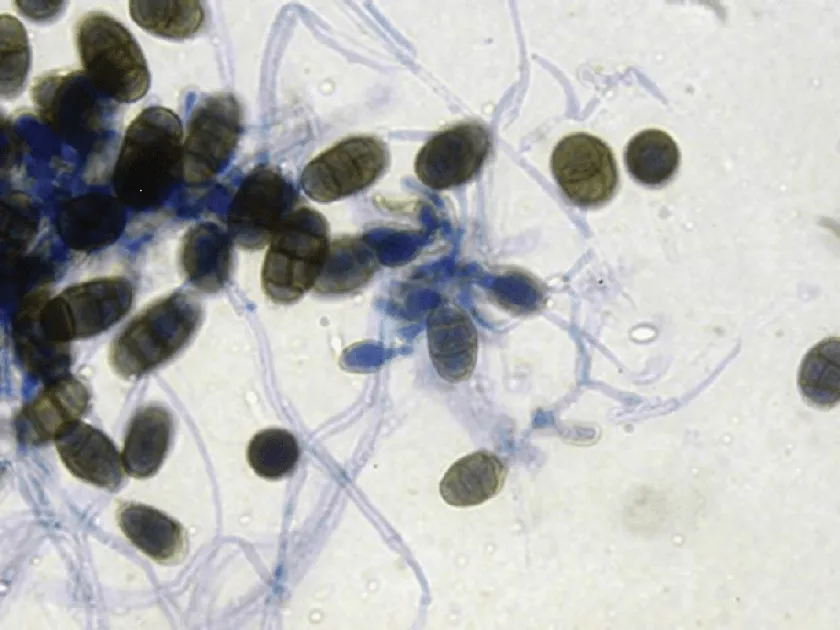
Description
Symptoms
The disease manifests initially as small, chlorotic spots on leaves and leaf sheaths. As the fungal colonization progresses, these spots turn dark brown or black due to the dense accumulation of conidia.
A distinctive feature is the development of a velvety or powdery surface texture within the spots, which indicates the presence of fungal sporulation. These lesions are often irregular in shape and tend to coalesce as the infection spreads.
Severe infection leads to the premature yellowing and senescence of the lower leaves. If the disease persists, the necrotic areas can extend to the upper leaves and stems, severely impacting the plant's health.
In humid conditions, the sporulation becomes more pronounced, resulting in darker lesion colors. Diagnostic identification often requires microscopic examination to distinguish it from other cereal leaf spot diseases.
Although it primarily attacks foliage, in highly susceptible plants or under prolonged wet conditions, the fungus may colonize glumes and other parts of the inflorescence.
Pathogen
The causative agent of the disease is the fungus Pithomyces graminicola, belonging to the Ascomycota division. It functions primarily as a saprotroph on dead plant tissues but can act as a pathogen under favorable environmental conditions.
The biological cycle of the fungus involves the production of abundant conidia on the surface of infected tissues. These conidia are dark-pigmented and structurally resilient, allowing them to withstand fluctuating temperatures and solar radiation.
Dissemination is largely wind-borne, enabling the spores to cover significant distances and infect healthy plants within a field or across neighboring areas. Upon landing on a suitable host, the spores germinate in the presence of moisture and infect the plant.
This fungus exhibits a wide host range, primarily infecting various cereal species and wild grasses. These grasses act as an essential reservoir for the pathogen during the off-season.
Molecular studies indicate that the fungus can adapt to different agro-climatic conditions, ensuring its persistence in soil debris and stubble, where it remains viable until the next growing season.
Conditions for development
The development of Pithomyces leaf spot is favored by moderate temperatures ranging from 20°C to 25°C and high relative humidity levels.
Frequent rainfall, heavy dews, and prolonged fog are critical environmental triggers. These conditions maintain the necessary moisture on the leaf surface for spore germination and successful fungal entry into the host.
Agricultural practices play a major role in disease prevalence. Leaving crop residues on the soil surface without incorporation provides a rich substrate for the fungus to survive and multiply.
High-density planting that restricts airflow leads to a humid microclimate within the crop canopy, which accelerates the spread of spores and disease development.
Plants under physiological stress, such as nutrient deficiencies or pest damage, are significantly more vulnerable to infection compared to vigorous, well-nourished crops.
Why it matters
The primary economic harm is caused by the reduction of the photosynthetic leaf area, which limits the plant's ability to accumulate biomass and fill grains effectively.
Infection disturbs the water balance and metabolic functions, leading to premature aging and a shortened vegetation period for the crop.
As a result, grain yield components, such as thousand-kernel weight and grain density, are negatively affected, reducing both total yield and market quality.
Under heavy infection pressure, yield losses can reach 10-20%. The cumulative effect of these losses poses a risk to the profitability of cereal production.
Furthermore, weakened plants are more susceptible to secondary infections and opportunistic pests, leading to further crop degradation and field-wide damage.
Protection
An effective control strategy involves integrating cultural practices with chemical protection to manage the infection risk throughout the season.
Crop rotation is the foundation of management; alternating cereals with non-host crops helps to break the disease cycle and deplete the soil inoculum levels.
Proper management of crop residues, including mechanical incorporation into the soil or deep plowing, is essential to minimize the fungal source for the next season.
- Application of systemic fungicides at the early onset of disease symptoms
- Selection of resistant or tolerant cereal cultivars
- Balanced fertilization to improve overall plant vigor and immunity
- Effective weed control to eliminate alternative hosts
- Optimizing planting density to ensure proper canopy aeration
Discussion
No discussions yet — be the first.