
Parasitic Bolete
Pseudoboletus parasiticus
The Parasitic Bolete (Pseudoboletus parasiticus) is a distinctive fungal species within the Boletaceae family, notable for its obligate parasitic lifestyle.
What the section contains
Parasitic Bolete
The pathogen is a mycelium that infects the fruiting bodies of various fungi, most commonly species of the genus Scleroderma, also known as earthballs.
Unlike saprotrophic mushrooms, this species requires a host organism to complete its life cycle, deriving its primary nutrients from the host's tissues.
Mycologists classify it as a necrotrophic parasite because it actively consumes and decomposes the tissues of the host fungus as it grows.
Its biological cycle is intricately linked to the presence of its host, without which the Parasitic Bolete cannot successfully produce its own fruiting bodies.
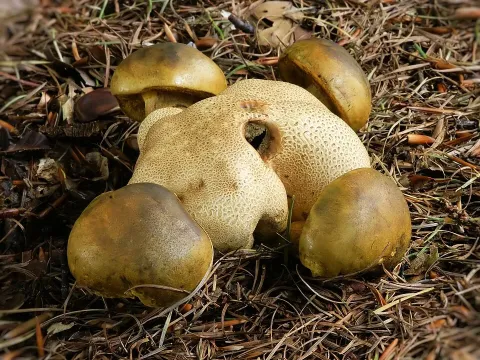
The primary symptom of infection is the appearance of small, yellowish, or brownish mushroom caps growing directly from the surface or base of the host.
As the infection progresses, the host fungus becomes deformed, loses its firm texture, and begins to show signs of premature decay and tissue breakdown.
Visually, the infected host often looks like a conglomerate, with the parasitic bolete clusters covering significant portions of the host's surface.
When the specimens are cut, internal discoloration and degradation of the host's structure are visible, caused by the penetration of the parasite's hyphae.
The fruiting bodies of the parasite are typically small, ranging from 2 to 7 cm, and often appear in tight groups that tightly adhere to the host's skin.
The development of the Parasitic Bolete depends heavily on the presence of a healthy population of host fungi, specifically Scleroderma earthballs.
High humidity and moderate temperatures during the late summer and autumn months create optimal conditions for spore germination and rapid mycelial growth.
The fungus is commonly found in deciduous forests with sandy or well-drained soils, which maintain the necessary moisture levels in the forest floor.
Spore dissemination is carried out primarily by wind and insects that forage on fungal fruiting bodies, effectively spreading the pathogen to new hosts.
The mycelium can persist in the soil for extended periods, remaining dormant until chemical cues from a suitable host trigger a new cycle of infection.
The primary harm caused by the Parasitic Bolete is the significant reduction in the reproductive success of the host mushroom populations.
By consuming the nutrients meant for the host's growth, the parasite limits the spread and viability of the host fungus within the forest ecosystem.
In environments where mycorrhizal fungi are essential for tree health, the degradation of earthball populations can potentially impact the local forest dynamics.
For scientific or educational collections, the presence of the parasite renders infected samples unsuitable for study due to the resulting tissue degradation.
Mass outbreaks can lead to the localized decline of host species, disrupting the biodiversity of fungal communities in a specific forest tract.
In most natural settings, active control measures are not implemented because the fungus is considered a natural part of the ecosystem.
However, in managed areas or for conservation purposes, monitoring and the removal of heavily infected specimens can help reduce the local spore load.
Maintaining optimal soil moisture and preventing the introduction of contaminated soil from infected areas are key preventative strategies.
Integrated management should focus on preserving the health of the host population rather than targeting the parasite directly, as the parasite is a niche species.
- Regular monitoring of host populations in vulnerable forest areas.
- Sanitary removal and disposal of heavily infected fungi.
- Preventing the transport of contaminated forest floor material.