
Parasitic bolete (mycoparasitism)
Pseudoboletus
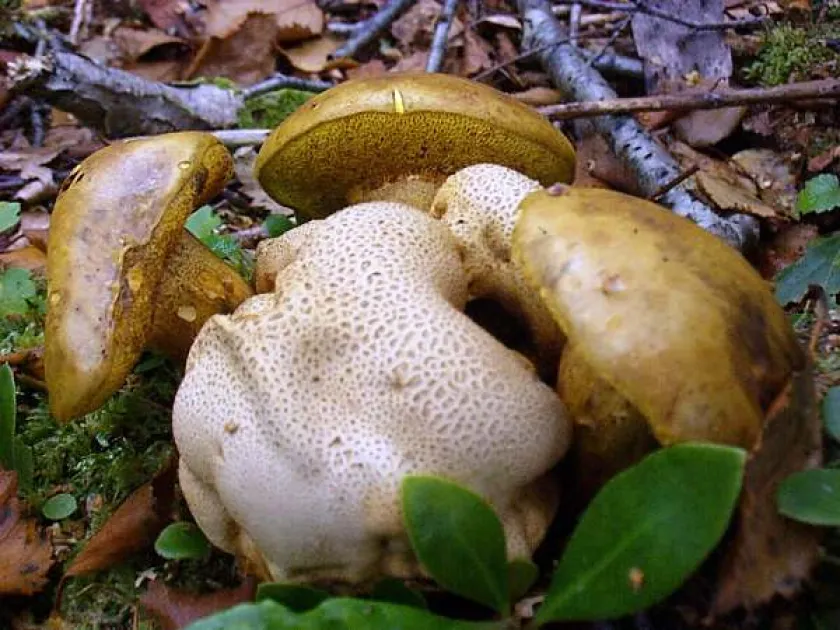
Description
Symptoms
The most visible sign of presence is the appearance of small, yellowish-brown caps of Pseudoboletus emerging from the surface of an earthball mushroom.
Early stages of infection are often invisible to the naked eye until the parasite begins to develop its own fruiting body on the host.
The host mushroom may show signs of deformation, discoloration, or tissue softening as the parasite absorbs nutrients and interferes with normal development.
Localized patches of yellow hyphae or mycelial growth on the surface of the host are key diagnostic features for identifying this parasitic interaction.
These symptoms occur strictly on fungal fruiting bodies in forest habitats and are never observed on any form of cultivated vegetation.
Pathogen
The causal agent is the fungus Pseudoboletus parasiticus, a specialized mycoparasite belonging to the Boletaceae family. Unlike typical fungi, its life cycle depends on infecting other mushrooms.
The primary host for this fungus is the Scleroderma genus, commonly known as earthballs. The parasite colonizes the fruiting bodies of these mushrooms to acquire nutrients.
It is crucial to note that this organism is not a plant pathogen. It does not affect crops, orchard trees, or ornamental plants, posing zero threat to agricultural production.
The biology of the fungus involves mycelial penetration into the host tissue. This specialized interaction is highly localized and does not extend to the root systems or vascular tissues of plants.
In the field of agronomy, this organism is considered irrelevant to plant health and is not classified as a disease of agricultural interest.
Conditions for development
Development is heavily dependent on high moisture levels and specific forest conditions that support the growth of the host mushrooms.
Optimal environmental conditions include humid soil environments and moderate temperatures, which facilitate the spread of spores to potential new hosts.
The density of host fungi within a forest patch is a major limiting factor for the establishment and successful spread of the parasite.
Spore dispersal relies on environmental factors such as wind, rain, and animal activity within the forest floor ecosystem.
The life cycle is closely synchronized with the growing season of the host, making it a seasonal occurrence limited to specific forest environments.
Why it matters
There is no economic harm or agricultural damage associated with this fungus. It does not attack any plant species and does not contribute to crop loss.
As it is restricted to other fungi, it causes no issues for horticultural or commercial plant management programs.
The ecological impact is confined to the population dynamics of the host mushroom species, which does not interfere with forest health or human interests.
There are no toxic or pathogenic risks to human health in an agricultural setting, nor is there any interference with the soil health or crop productivity.
The presence of this fungus is considered a natural occurrence and is generally ignored by agricultural agencies and crop protection services.
Protection
No control measures are necessary. Since it is not a plant disease, the use of pesticides or other protective measures is neither required nor recommended.
Agronomic strategies such as crop rotation, chemical spraying, or soil treatment have no effect on this organism and are completely inapplicable.
No preventative actions are required for farmers or growers, as the parasite remains within the fungal domain of forest ecosystems.
If encountered in nature, it is advisable to leave it undisturbed as part of the natural biological diversity of the forest ecosystem.
Research on this species is limited to the fields of mycology and forest ecology, where it is studied for its unique evolutionary and ecological adaptations.
Discussion
No discussions yet — be the first.