
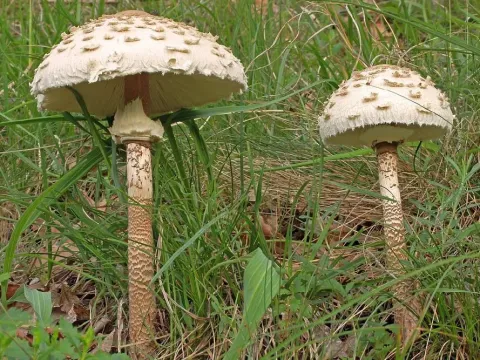
Parasol mushroom
Macrolepiota procera
Important clarification: The Parasol mushroom (Latin Macrolepiota procera) is not a plant disease. It is a saprotrophic fungus and does not cause any pathological conditions in plants.
What the section contains
Parasol mushroom
This species is not a pathogen and does not infect agricultural crops. Its life cycle is based on the decomposition of organic matter, meaning it plays no role in crop damage or diseases.
Unlike parasitic fungi, the Parasol mushroom does not penetrate living host tissues, cause rot, or lead to any agricultural yield loss.
In ecology, this mushroom acts as a decomposer, breaking down leaf litter and organic soil material, which contributes to the nutrient cycle in soil ecosystems.
Classifying this organism as a disease is biologically incorrect, as it is a beneficial part of natural soil health and ecosystem biodiversity.
The fruiting body is distinctively large, often reaching heights of 30–40 cm. The cap, which starts egg-shaped, expands into a broad, umbrella-like shape measuring up to 30 cm across.
The cap surface is covered with brownish, shaggy scales on a lighter background, creating a pattern reminiscent of a parasol, hence the common name.
The stem is tall, sturdy, and hollow, characterized by a prominent, movable ring located near the top, which is a key identifying feature.
The gills are white or cream-colored, free from the stem, and quite broad. As the mushroom matures, they may show a subtle pinkish discoloration.
The flesh is white, soft, and has a mild, nutty aroma, making it distinct from smaller, poisonous species that often lack the movable ring or have different scale patterns.
Parasol mushrooms thrive in well-lit environments such as forest clearings, meadows, open woodlands, and parklands where light penetration is adequate.
They require soil rich in organic matter to support the mycelium. The species is highly dependent on moderate moisture levels and temperature stability.
The fruiting season typically occurs from mid-summer through autumn, provided there is sufficient rainfall to initiate the development of the fruiting bodies.
They are not found in densely shaded forests, as they require specific soil temperatures and microclimatic conditions found in more open areas.
Spores are dispersed by wind, allowing the fungus to colonize new organic-rich soil patches throughout forest edges and grassy terrains.