
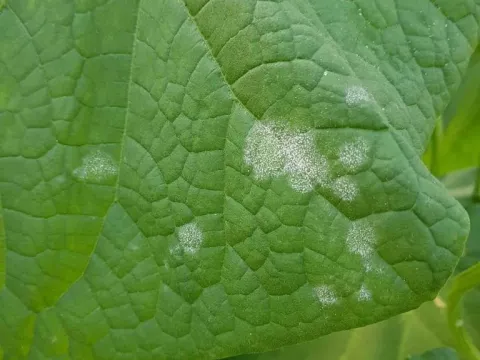
Powdery mildew of cucurbits
Podosphaera xanthii
The causative agent of this disease is the obligate parasitic fungus Podosphaera xanthii, which specifically targets members of the Cucurbitaceae family.
What the section contains
Powdery mildew of cucurbits
It is an ectoparasitic fungus that develops primarily on the surface of plant tissues, creating a characteristic white, powdery appearance.
The pathogen reproduces via conidia, which are wind-dispersed and capable of infecting healthy plants rapidly under favorable environmental conditions.
It uses specialized structures called haustoria to penetrate the plant epidermis and extract essential nutrients, weakening the host plant significantly.
The fungus survives the winter as chasmothecia on plant debris or as mycelium on alternative hosts, ensuring its persistence in the environment.
Initial symptoms consist of small, faint white spots appearing on the upper surface of older leaves, stems, and leaf petioles.
These spots eventually merge, covering the entire leaf surface with a thick, white, fungal mat that resembles a dusting of flour.
As the infection progresses, affected leaves turn yellow, become brittle, curl upwards, and finally necrotize, leading to premature leaf drop.
Under severe pressure, the fungal growth can spread to stems and even developing fruit, causing blemishes and reducing quality.
- White powdery spots on foliage.
- Leaf chlorosis and eventual necrosis.
- Stunted growth of the main vine.
- Reduced fruit set and development.
- Premature fruit sunscald due to leaf loss.
Powdery mildew development is favored by warm days followed by cool nights, which often lead to high relative humidity or dew formation.
Optimal temperatures for the fungus range between 20°C and 25°C, making it a common issue during the mid-to-late growing season.
Poor air circulation, often caused by high plant density in greenhouses or field settings, allows the pathogen to establish itself more effectively.
Excessive nitrogen fertilizer promotes rapid, soft tissue growth that is highly susceptible to penetration by the fungal hyphae.
Although the fungus does not require free water for infection, high humidity levels are essential for the survival and germination of its spores.
The primary damage is caused by the reduction of the photosynthetic leaf area, which severely restricts the plant's energy production.
This physiological stress leads to a significant reduction in fruit yield, both in terms of the number of fruits and their individual size.
Infected cucurbits often lose their commercial value due to skin blemishes, poor flavor profile, and reduced shelf life post-harvest.
The loss of canopy cover leaves the developing fruit exposed to direct sunlight, which can lead to severe sunscald damage.
If left unmanaged, the disease can cause total crop failure, necessitating high expenditures for fungicides to mitigate potential losses.
Implementing a strict crop rotation schedule is vital to break the life cycle of the pathogen and reduce the initial inoculum level.
The selection of resistant or tolerant cultivars is the most sustainable and efficient strategy for managing powdery mildew in large-scale operations.
Pruning and proper spacing between plants improve airflow, which creates a less favorable environment for fungal spore germination.
Regular monitoring of fields allows for early detection, enabling the application of targeted fungicides before the infection becomes uncontrollable.
Managing the greenhouse microclimate through improved ventilation and humidity control is crucial for preventing outbreaks in protected cultivation.