
Delicatula integrella
Delicatula integrella
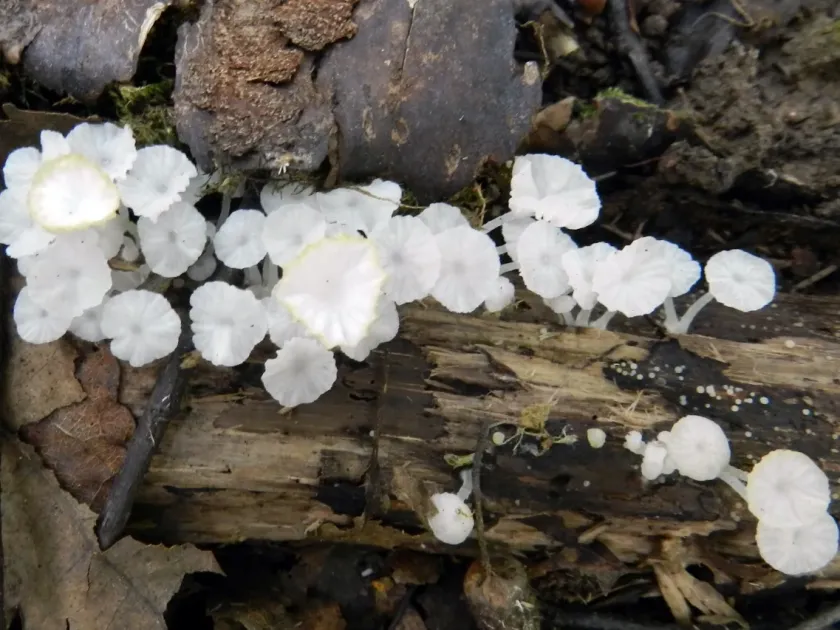
Description
Pathogen
Delicatula integrella is a species of mushroom in the Marasmiaceae family. It is important to clarify that this fungus is a saprotroph and not a plant pathogen.
The fungus obtains its nutrition exclusively from dead and decaying organic matter, specifically leaf litter and rotten wood. It does not possess the biological capability to attack or infect living plants.
As a decomposer, it plays a vital role in nutrient cycling within forest ecosystems. It breaks down complex organic materials into simpler substances, contributing to soil fertility.
Morphologically, the fungus is characterized by small, white, delicate basidiocarps with widely spaced gills. Its life cycle is entirely dependent on moisture and decaying wood remnants.
Because it is not a parasite, it does not form colonies on agricultural crops, whether in the field or in storage. It is essentially a neutral organism in agricultural contexts.
Conditions for development
The development of Delicatula integrella is strictly tied to high-humidity environments. It requires a substrate that is consistently wet to support its mycelial growth and fruiting body formation.
The fungus is commonly found in damp woodlands, riparian areas, and shaded locations with significant amounts of woody debris. It thrives during periods of frequent rainfall and moderate temperatures.
Substrate requirements are specific to wood that has already begun to decompose. Unlike pathogens that attack healthy tissues, this species acts as a secondary colonizer of dead material.
Climate factors such as persistent moisture are critical for its emergence. Dry weather conditions inhibit its development, as the fruiting bodies are highly susceptible to desiccation.
In managed agricultural lands, the presence of such fungi is rare unless there is unmanaged forest-like debris or poorly drained soil, which might favor other pathogens, even if this species itself is harmless.
Why it matters
There is no economic harm associated with Delicatula integrella. It is classified as an innocuous saprotrophic fungus that does not interfere with crop development or yield.
It does not cause any diseases such as wilting, necrotic spots, or rotting in living plant tissues. Therefore, it has no impact on agricultural productivity or crop health.
Farmers and agronomists do not need to implement any monitoring or control programs for this species. It does not fall under the category of pests or diseases.
Confusing this benign species with parasitic fungi is a common diagnostic error. Proper identification ensures that unnecessary chemical fungicide applications are avoided.
The species provides ecological benefits by recycling carbon and minerals. It should be viewed as a component of healthy natural processes rather than a threat to agricultural operations.
Discussion
No discussions yet — be the first.