
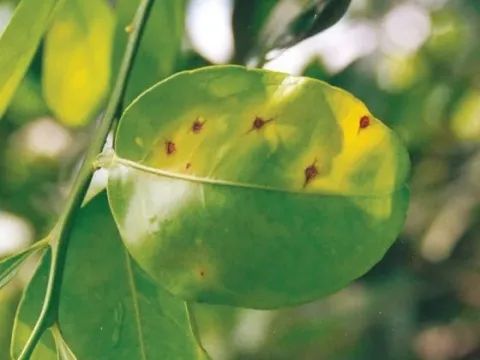
Brown spot of citrus
Physoderma citri
The causative agent of this disease is the chytrid fungus Physoderma citri. This pathogen belongs to a group of microorganisms known for their dependence on water for their reproductive cycle.
What the section contains
Brown spot of citrus
The fungus produces motile zoospores that require free moisture to swim and infect the host plant. It survives in the soil and on infected plant debris as resting spores, which are highly resistant to adverse conditions.
Once conditions are favorable, these spores germinate and release zoospores that penetrate the leaf and stem tissues of citrus trees. The fungus grows intercellularly, absorbing nutrients and causing localized tissue death.
The specificity of Physoderma citri limits its impact primarily to citrus species, making it a targeted threat in commercial and home orchards alike.
Understanding the life cycle of this pathogen is crucial for predicting outbreaks, especially in regions with distinct rainy seasons or high humidity levels throughout the year.
The initial symptoms manifest as small, brown, circular spots on the leaf blades. These spots often develop a yellow halo as the fungus colonizes the surrounding tissue.
As the disease progresses, the spots expand and may coalesce, creating large necrotic patches. The central area of the spots often shows tiny, dark structures representing the reproductive bodies of the fungus.
Deformation of the leaf blade is common, particularly in younger, more succulent growth. In severe cases, the infected leaf tissue may dry up and crack, leading to a ragged appearance of the canopy.
On fruit, brown spots can appear, which significantly reduce market value. While the infection is typically superficial, it impacts the aesthetics and can predispose the fruit to further decay.
Premature leaf drop is a hallmark of significant infection. A heavily infected tree will show signs of sparse canopy, which directly reflects the stress placed upon the plant's metabolic functions.
High relative humidity is the primary catalyst for the development of brown spot of citrus. Environments with frequent rainfall or heavy morning dew are ideal for the activity of Physoderma citri.
Temperatures ranging from 20 to 26 degrees Celsius provide the perfect conditions for the rapid multiplication and spread of fungal spores across the grove.
Poor orchard management, such as high-density planting, restricts airflow and creates pockets of stagnant, humid air. This prevents leaves from drying quickly after rainfall, favoring the pathogen.
Overhead irrigation is a significant risk factor. The direct contact of water droplets with the foliage mimics rain, providing a medium for zoospores to move and colonize new, healthy tissues.
Plant health is also a factor; trees stressed by nutritional deficiencies, poor soil conditions, or pest infestations are more susceptible to infection and show faster rates of colonization than vigorous trees.
The main impact of the disease is the reduction in photosynthetic leaf area. This depletion of energy-producing tissue slows down the tree's growth and affects its ability to produce high-quality fruit.
Chronic infections lead to significant yield losses over time. Trees that are constantly battling fungal stress often struggle to maintain consistent fruit production, leading to biennial bearing patterns.
The loss of leaves early in the season weakens the tree's overall vigor, making it more susceptible to environmental stress, including winter cold and summer heat waves.
Economic damage is twofold: the cost of disease management through fungicides and labor, and the financial loss due to damaged fruit that fails to meet market quality standards.
In nursery settings, the threat is even greater. Brown spot can devastate young saplings, potentially leading to the loss of entire batches of stock due to the inability of the young plants to recover.
Control measures start with sanitation. Removing and destroying fallen leaves and infected twigs is essential to reduce the inoculum load in the orchard during the off-season.
Proper pruning practices improve canopy aeration, allowing the sun and wind to dry the leaves quickly, which directly hinders fungal growth.
Chemical control focuses on preventive application of copper-based fungicides. These protect the foliage surface and prevent spore germination if applied before conditions become favorable for infection.
Implementing drip irrigation is highly recommended to eliminate the moisture buildup associated with overhead systems. Keeping the canopy dry is one of the most effective ways to break the disease cycle.
- Regular pruning to enhance airflow.
- Removal and burning of fallen infected foliage.
- Use of copper-based fungicides as a preventive measure.
- Transitioning from overhead to drip irrigation systems.
- Maintaining optimal tree health to increase natural resistance.