
Guava phomopsis blight
Phomopsis psidii
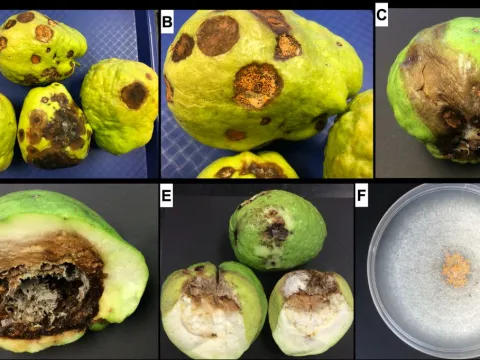
The early symptoms of Guava phomopsis blight involve the appearance of small, brown to black spots on young guava fruits, which gradually expand.
What the section contains
Guava phomopsis blight
As the infection progresses, minute black structures called pycnidia develop in the centers of these necrotic lesions, indicating fungal sporulation.
Leaves may exhibit dark, irregular spots that eventually coalesce, leading to severe chlorosis and premature leaf drop across the affected tree canopy.
Twigs and branches show sunken cankers that can girdle the affected area, resulting in dieback of the terminal parts and general wilting.
Under humid conditions, a greyish fungal mycelial mat may cover the surface of rotten fruits, making them completely unmarketable and prone to decay.
The disease is caused by the deuteromycete fungus Phomopsis psidii, which is synonymous with the teleomorph Diaporthe psidii.
The pathogen survives within infected branches, dead twigs, and mummified fruits left on the tree or fallen on the ground throughout the year.
Spread of the disease occurs via conidia, which are disseminated primarily by splashing rain, irrigation water, and wind-driven moisture.
Infection cycles are initiated when conidia land on susceptible plant tissues and germinate under optimal environmental conditions, penetrating the plant cuticle.
The fungus maintains its lifecycle by utilizing the nutrients from the host plant's necrotic tissues to produce subsequent generations of spores.
High humidity and prolonged periods of rainfall are the most critical factors for the rapid spread and development of Phomopsis psidii.
Optimal temperatures for fungal growth and spore germination are typically found within the range of 20°C to 28°C (68°F to 82°F).
Poor orchard sanitation, characterized by dense foliage and lack of pruning, creates stagnant microclimates that encourage the proliferation of the fungus.
Mechanical injuries on fruits caused by hail, thorns, or insect punctures act as entry points for the pathogen to infiltrate internal tissues.
Lack of proper air circulation within the tree canopy keeps the foliage damp for longer periods, providing extended windows for infection to occur.
The primary economic impact is the significant loss of fruit yield, as infected fruits rot rapidly and are rejected for local or international markets.
Pre-harvest fruit drop induced by the pathogen significantly reduces the overall harvest volume and profitability of commercial guava orchards.
Damage to the structural branches leads to canopy dieback, which limits the future productive capacity of the guava trees over many years.
Internal fruit rot can often go unnoticed during early stages, leading to severe post-harvest losses during storage and transit to distribution centers.
Chronic infestation weakens the overall physiological health of the orchard, requiring increased inputs for tree recovery and rehabilitation efforts.
Orchard sanitation is the first line of defense, requiring the removal and destruction of all infected twigs, branches, and fallen mummified fruits.
Proactive fungicide application using copper-based or systemic fungicides is effective in protecting fruit sets during high-risk rainy seasons.
Proper pruning techniques should be employed to improve airflow and light penetration, effectively reducing the humidity levels within the canopy.
Effective management of fruit-piercing insects is essential to minimize the physical entry points for the fungus into the fruit skin.
Implementing a regular scouting program allows growers to detect and remove initial infection sources before the blight becomes an epidemic.