
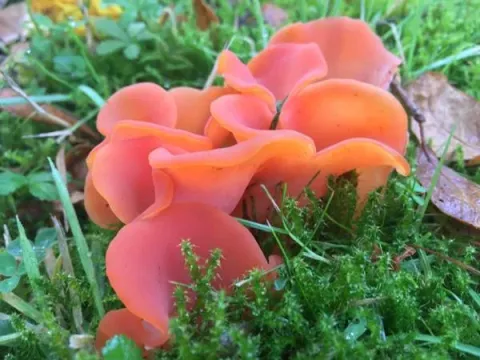
Guepinia helvelloides
Guepinia helvelloides
Guepinia helvelloides (syn. Tremiscus helvelloides) is a species of jelly fungus belonging to the Auriculariales order. It is crucial to clarify that this organism is not a plant disease or a pathogen.
What the section contains
Guepinia helvelloides
In modern agricultural and mycological science, this fungus is classified as a saprotroph. This means it derives its nutrients from dead or decaying organic matter, such as wood debris, rather than living plants.
Biologically, it is a gelatinous fungus known for its bright pink, red, or orange funnel-shaped to tongue-shaped fruit bodies, which are quite distinct in forest environments.
Unlike pathogenic fungi, it lacks the enzymes required to penetrate and damage living plant cells. Its metabolism is specifically evolved to break down cellulose and lignin in dead wood that has already lost its vitality.
Therefore, labeling this species as a plant disease is a common misunderstanding. It plays a neutral or even beneficial role in the environment and poses no threat to crops or garden plants.
The fruit bodies range from 3 to 10 cm in height, appearing soft and gelatinous. They often grow in clusters, sometimes fusing at the base, creating eye-catching shapes.
The surface is typically smooth or slightly wrinkled, with colors ranging from pale pink to intense orange. When the air becomes dry, the fruit bodies shrink, harden, and darken significantly.
The fungus is primarily found on decaying coniferous wood or on wood fragments buried in soil that are in advanced stages of decomposition.
Surrounding plants exhibit no symptoms of stress, such as necrosis, chlorosis, or wilting. The roots and stems remain healthy, as the fungus does not establish parasitic relationships.
Phytosanitary inspections confirm that there is no tissue degradation on live plants adjacent to the fungus, verifying its role as a harmless organism in the landscape.
The development of the mycelium and the emergence of fruit bodies are heavily dependent on high humidity and rainfall, which are essential for its growth cycles.
The optimal temperature for its development is generally moderate, typically between 15 °C and 20 °C. It prefers cool, shaded areas where moisture persists in the leaf litter and soil.
The substrate must be dead wood in a state of active decomposition. It thrives where other primary decomposers have already begun breaking down the organic material.
Spores are dispersed by wind and require specific environmental conditions to germinate, primarily needing access to suitable decaying woody debris in a stable, moist habitat.
The fungus is sensitive to environmental chemicals and heavy pollutants. It is rarely found in areas treated with high concentrations of fungicides or synthetic fertilizers.
This fungus causes no harm to agricultural or horticultural production. It lacks parasitic capabilities and cannot infect living crops, fruits, or woody tissues.
Conversely, it contributes to the ecosystem by participating in the decomposition of plant residues, which aids in the natural recycling of nutrients and soil structure formation.
In agricultural practice, it is not monitored as a threat, as it does not cause economic damage. It remains a benign inhabitant of woody forest or garden zones.
The absence of reports regarding damage to commercial crops confirms its safety. Farmers do not need to implement any monitoring or protective measures against this specific species.
Any presence of these mushrooms on tree stumps or mulch is simply a sign of organic material returning to the soil and does not indicate a health issue for the trees.
No control measures are necessary, as the fungus is not a pathogen. The application of fungicides or other chemical treatments would be ineffective and unnecessary.
If the appearance of the fungus is aesthetically undesirable, simply removing the decaying wood source or old stumps will prevent further growth of fruit bodies.
Improving drainage in garden areas and reducing excessive moisture will naturally discourage the development of saprotrophic fungi by creating a drier microclimate.
Prevention relies on general garden hygiene: keeping the area free of unnecessary rotting wood and debris will maintain a clean and managed landscape.
There are no quarantine regulations or restrictions on the movement of plants linked to this fungus, confirming its status as a completely harmless and ecologically useful species.