
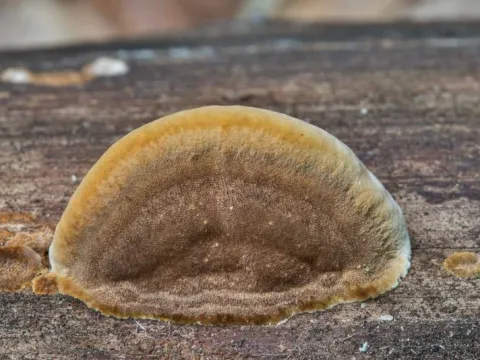
Phellinus gilvus
Phellinus gilvus
Phellinus gilvus is a significant wood-decay fungus belonging to the Hymenochaetaceae family. It is a pathogen that primarily causes white heart rot in various deciduous tree species.
What the section contains
Phellinus gilvus
The fungus acts as a parasite that invades the inner heartwood of trees, breaking down lignin and cellulose, which are essential components for the structural integrity of timber.
As a basidiomycete, it produces tough, perennial fruiting bodies that persist on the tree trunks for years, continuously releasing spores to propagate in the surrounding area.
The mycelium of this fungus spreads through the xylem and phloem, eventually compromising the tree's ability to transport nutrients and water from the soil to the crown.
Infection typically occurs through wounds in the bark, caused by pruning errors, weather events, or previous mechanical damage, providing an entry point for the pathogen.
The most visible sign of infection is the emergence of bracket-like fruiting bodies on the trunk, which are typically yellowish-brown or rusty-brown in color.
These fruiting bodies often have a velvety or hairy texture when young, becoming woody, thick, and firm as they mature over several growing seasons.
Wood decay associated with Phellinus gilvus appears as a white, spongy rot that causes the timber to lose its mechanical strength and crumble easily under pressure.
Dark, discolored lines may sometimes appear within the affected wood, marking the zones of fungal activity as the rot progresses through the heartwood.
- Hard, shelf-like structures on tree trunks.
- Bark cracks and localized tissue necrosis.
- Crown thinning and premature leaf drop.
The development of this pathogen is favored by humid conditions and moderate temperatures, which create an optimal environment for spore germination and growth.
Trees that are already stressed by drought, nutrient deficiencies, or pest infestations are significantly more susceptible to successful colonization by Phellinus gilvus.
Poor orchard management, such as leaving stumps or dead branches in the field, provides a reservoir for the fungus to persist and spread to nearby healthy trees.
Lack of proper aeration in dense forest stands or poorly maintained orchards contributes to higher humidity levels around trunks, facilitating the infection process.
Mechanical damage from machinery or wildlife creates entry points that, in the presence of high spore concentrations, lead to rapid infection of vulnerable hosts.
The primary threat posed by this fungus is the structural compromise of the tree trunk, which significantly increases the risk of windthrow and falling limbs.
By disrupting the internal transport systems of the tree, the infection leads to a gradual decline in tree vigor, reduced growth rates, and eventually the death of the host.
In agricultural settings, infected fruit trees exhibit lower yields and poor fruit quality, negatively impacting the economic viability of the orchard operation.
Timber value is greatly diminished due to the internal rot, making the wood unsuitable for construction or high-quality manufacturing purposes.
The fungus acts as an ongoing source of inoculum, threatening to infect neighboring healthy trees and leading to localized clusters of dying vegetation.
Effective management requires strict sanitation practices, including the prompt removal of infected trees and the destruction of all associated woody debris.
Proper wound care is essential; all pruning cuts or accidental injuries should be treated with appropriate fungicidal sealants to prevent the entry of fungal spores.
Regular monitoring of the orchard or forest stand allows for the early detection of fruiting bodies, enabling the removal of localized infections before they spread.
Enhancing tree vitality through balanced fertilization and irrigation helps the host plant better resist infection and recover from minor mechanical injuries.
In advanced stages of rot where structural integrity is lost, the safest and most recommended practice is the complete removal and disposal of the infected specimen.