
Phellodon
Phellodon
The genus Phellodon belongs to the Bankeraceae family and consists of basidiomycete fungi that are not classified as plant pathogens.
What the section contains
Phellodon
These organisms do not cause diseases in agricultural, horticultural, or field crops. They are primarily saprotrophic or mycorrhizal, living in forest soils.
The fungus develops its mycelium within the leaf litter of forest floors, where it decomposes organic matter or forms symbiotic associations with tree roots.
There is no record of Phellodon species acting as parasites on economically significant plants, making them ecologically beneficial rather than harmful.
In an agronomic context, these fungi are not a subject of phytopathological study, as they pose no risk to commercial plant production.
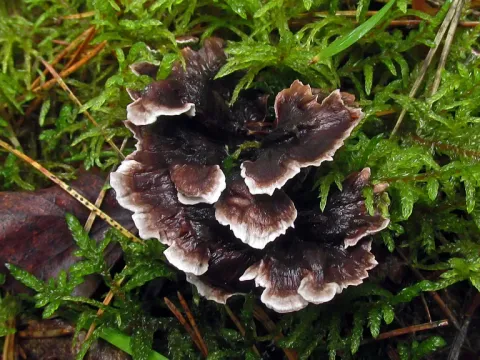
The main morphological features of Phellodon are the presence of tough, leathery fruiting bodies with a characteristic funnel shape.
The underside of the cap is covered with dense, small spines, which is the defining diagnostic feature that distinguishes it from gilled mushrooms.
Fruiting bodies vary in color, typically exhibiting shades of gray, brown, or near-black, often appearing quite dark in their natural habitat.
A notable characteristic is the pleasant, often curry-like or fenugreek-like aroma that develops particularly when the mushrooms are dried.
Mycelial mats can sometimes be seen beneath the surface of the litter, anchoring the fruiting bodies to the decomposing organic substrate.
Phellodon thrives in cool, moist, and acidic forest environments, particularly under coniferous trees where needle litter is abundant.
The development of fruiting bodies typically occurs in late summer and autumn, triggered by consistent rainfall and decreasing temperatures.
These fungi require an undisturbed substrate, which is why they are rarely found in cultivated fields or managed garden areas.
High sensitivity to soil pollution and rapid changes in forest chemistry limits their distribution to stable, natural, or semi-natural forest ecosystems.
Effective spore dispersal relies on natural air currents, but successful germination requires specific mycorrhizal hosts that are usually absent in farmland.
Phellodon causes no harm to agricultural plants, as it lacks the physiological mechanisms required to invade living plant tissues.
There is no economic damage associated with this genus, and it does not affect the yield or health of food crops in any detectable way.
The interaction with woody species is often beneficial, as many Phellodon species form ectomycorrhizae that help trees absorb water and nutrients.
Misidentifying these fungi as crop diseases is a common mistake that can lead to unnecessary and potentially harmful chemical applications in a garden.
Protecting these fungi is often considered a sign of healthy soil, as they are sensitive to environmental degradation and chemical overuse.
No control measures are necessary because Phellodon is not a pest or a disease-causing organism in plant pathology.
If encountered in a garden or forest-edge planting, no action is required; they do not interfere with the growth of ornamental or food-bearing plants.
For those wishing to discourage their growth for aesthetic reasons, simply removing the fruiting bodies or improving drainage in the area is sufficient.
Prevention involves maintaining healthy, well-drained soil conditions and avoiding the accumulation of excessive forest litter in high-maintenance zones.
- Do not apply fungicides;
- Maintain proper soil pH;
- Appreciate their presence as a sign of environmental health.