
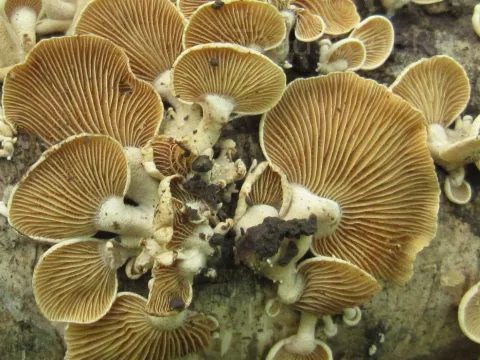
Panellus stipticus
Panellus stipticus
Panellus stipticus is a wood-decaying fungus belonging to the Mycenaceae family. Although often incorrectly classified as a plant disease, it is biologically a xylotrophic saprotroph.
What the section contains
Panellus stipticus
The agent is the mycelium of the fungus, which penetrates wood through bark injuries or open cuts. Unlike parasites, it primarily feeds on dead plant tissues.
The fruiting body consists of a fan-shaped cap and a short stem. A distinct feature is its bioluminescence, which is visible in low-light conditions.
The fungus actively secretes enzymes capable of breaking down lignin and cellulose, turning the wood structure into a soft, fibrous mass.
Reproduction occurs through spores, which are dispersed by wind or insects to settle on damp wooden surfaces.
The primary signs of infestation are fruiting bodies forming in dense clusters on trunks, stumps, or fallen branches.
The caps are tan or brownish, with a surface covered in fine scales. When dry, they become quite tough and leathery.
Wood infected by the fungus takes on a bleached appearance, indicating the development of white rot.
In advanced stages, the wood structure becomes spongy and crumbles easily under manual pressure.
At night, clusters of the fungus may exhibit a faint greenish glow, a characteristic trait of this specific biological species.
Active growth requires high humidity and moderate temperatures ranging from +15 to +25 degrees Celsius.
It thrives on weakened trees, stumps of broadleaf species, or damp wood located in shaded areas.
The presence of open wounds on tree trunks significantly accelerates the mycelium colonization process.
Poor ventilation and moisture retention in forest areas or gardens are favorable conditions for its spread.
While usually found in forests, the fungus can potentially infect old fruit trees in orchards if proper maintenance is neglected.
The main danger lies in the destruction of wood, which leads to a gradual reduction in the structural integrity of trunks or branches.
Although it prefers dead tissue, the fungus can colonize deadwood sections on living trees, expanding the affected area over time.
The presence of mycelium promotes moisture retention within the wood, creating an ideal environment for other pathogenic microorganisms.
Affected trees become brittle, significantly increasing the risk of mechanical failure during strong winds.
Economic damage is expressed through the loss of wood quality and the need to remove infected trees to stop spore dispersal.
The primary prevention method is timely sanitary cleaning of the garden to remove stumps, decaying branches, and wooden debris.
It is essential to minimize wounds on trunks by promptly treating cuts with grafting wax or specialized wood antiseptics.
Maintaining tree health through proper irrigation and regular fertilization is crucial for building natural immunity.
Upon detecting the first fruiting bodies, they should be removed to prevent further spread of spores throughout the area.
The use of fungicide treatments is justified only for protecting valuable tree species and is typically applied by soaking or spraying wound sites.