
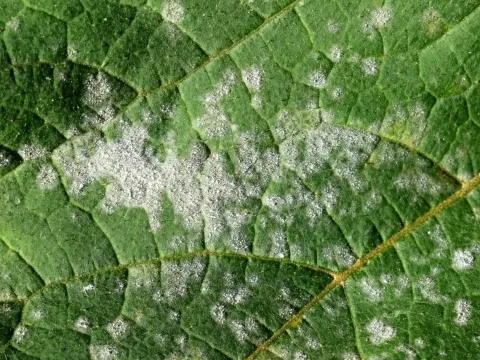
Cyclamen powdery mildew
Oidium cyclaminis
The causal agent of this disease is Oidium cyclaminis, a specialized fungus that primarily attacks plants within the Cyclamen genus. It is an obligate parasite, meaning it relies entirely on the living tissues of the host plant to survive and reproduce.
What the section contains
Cyclamen powdery mildew
The fungus develops a white mycelial network on the plant's surface. It penetrates the plant's epidermal cells using specialized structures called haustoria, which absorb essential nutrients, directly weakening the plant's metabolic functions.
Reproduction is carried out through the production of numerous conidia. These microscopic spores are easily dispersed by wind, splashing water, or handling, allowing the infection to move rapidly through a greenhouse or home environment.
The pathogen thrives in specialized conditions where host plants are densely populated. It can survive in soil or plant debris, making sanitation a critical component of any management strategy.
Understanding the biology of Oidium cyclaminis is essential because it is a highly host-specific pathogen. Its evolutionary adaptation to cyclamen makes it a persistent threat in commercial floral production.
The initial symptom is the appearance of small, white, powdery spots on the foliage. These spots resemble flour or dust and are the most common indicator of an active fungal infection.
As the disease progresses, the white patches enlarge and coalesce, eventually covering entire leaves, petioles, and flower stalks. The infected areas often become chlorotic, showing yellowing beneath the mycelial mat.
Infection significantly hampers the plant's ability to bloom. Flower stalks often become stunted or twisted, and developing buds may fail to open or wither prematurely, drastically reducing the aesthetic quality of the plant.
In advanced cases, the powdery growth becomes more dense and greyish. If left untreated, the underlying leaf tissue becomes necrotic, leading to leaf drop and structural decline of the plant.
Careful inspection of the foliage will reveal that while the powdery layer can be wiped off, the surface underneath remains damaged and dull, confirming that the fungus has successfully breached the leaf cuticle.
High relative humidity and moderate temperatures (between 18°C and 24°C) provide the optimal environment for the germination of fungal spores. This range is frequently encountered in indoor and greenhouse environments.
Poor ventilation is a major contributing factor. Stagnant air allows for localized high-humidity zones around the leaves, which promotes the rapid development and spread of the powdery mildew fungus.
Temperature fluctuations that cause condensation to form on the leaves create an ideal moisture film for spore germination. This is why proper air circulation is vital for healthy cyclamen growth.
Over-fertilization with nitrogen can encourage soft, succulent growth that is more susceptible to infection. Plants grown in low-light conditions may also develop thinner cell walls, making them easier targets for the fungus.
Contaminated tools, clothing, or even insects can act as vectors for the disease, moving spores from one plant to another within a growing facility.
The primary harm caused by cyclamen powdery mildew is the loss of commercial value. Plants exhibiting distorted growth or fungal residues are unsuitable for sale and often have to be discarded.
The infection significantly reduces the plant's photosynthetic efficiency by shading the leaf surface and damaging the epidermal cells. This depletion of resources leads to a decline in tuber health, affecting future blooms.
Powdery mildew makes the cyclamen vulnerable to secondary infections. Damaged tissues are often colonized by Botrytis (grey mold) or other opportunistic pathogens that can cause total plant collapse.
Growth stunting is a common consequence, where the plant stops producing healthy new leaves and becomes permanently disfigured. If the infection reaches the crown, it can lead to crown rot and death.
For large-scale growers, an outbreak of Oidium cyclaminis represents a significant financial risk, often requiring the implementation of expensive containment and chemical control protocols.
Cultural management is the first line of defense. Ensuring proper spacing between plants and maintaining adequate airflow through the greenhouse or room can significantly reduce the risk of infection.
Monitoring the environment to keep humidity levels controlled is crucial. If infection occurs, immediately isolate the affected plants to prevent the spread of spores to healthy individuals.
Biological treatments, such as those utilizing Bacillus subtilis, can be effective in suppressing the fungus without harsh chemical residues, making them suitable for home-grown collections.
- Regular sanitation of growing areas and tools.
- Application of sulfur-based fungicides (in appropriate temperature ranges).
- Systemic fungicides for severe infections (professional use).
- Careful watering practices to keep foliage dry.
Professional control strategies focus on integrated pest management (IPM), combining environmental adjustments, rigorous sanitation, and the targeted use of systemic fungicides to ensure long-term plant health.