
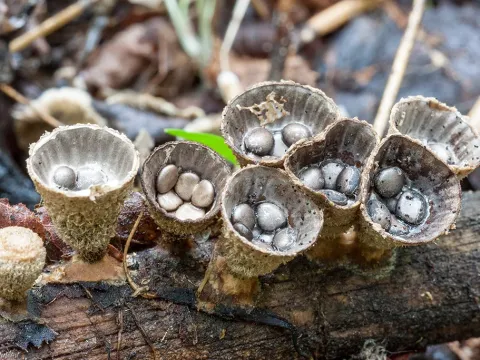
Bird's nest fungi
Nidulariaceae
Bird's nest fungi, belonging to the Nidulariaceae family, are a group of saprophytic fungi. They primarily decompose organic matter rather than attacking living plant tissues.
What the section contains
Bird's nest fungi
These fungi thrive on substrates such as wood chips, sawdust, straw, and compost. They play a crucial role in breaking down lignin and cellulose in the soil ecosystem.
The name comes from their unique fruiting bodies, which resemble tiny birds' nests containing small, egg-like spore capsules. These structures are typically very small, often less than 1 cm.
They are not considered plant pathogens. In agricultural practice, they are often mistaken for crop diseases, but they do not cause infections in vegetables, fruits, or flowers.
By consuming dead organic material, they act as decomposers, contributing to the recycling of nutrients back into the soil, which is generally beneficial for long-term soil health.
Bird's nest fungi flourish in high-moisture environments with abundant organic debris. They are most commonly found in shaded areas of gardens or greenhouses.
The development of these fungi is closely linked to the use of thick layers of uncomposted mulch. Proper ventilation and airflow are required to prevent their mass proliferation.
Spore dispersal is facilitated by physical impact, usually raindrops hitting the cup-shaped fruiting bodies, which catapults the spore "eggs" over a distance of up to 50 cm.
Temperatures ranging from 15°C to 25°C are ideal for the growth of their mycelium. During dry weather, they quickly desiccate and become virtually invisible.
Excessive irrigation or poor soil drainage creates the wet conditions necessary for these fungi to establish and produce fruiting bodies consistently throughout the growing season.
There is no direct harmful impact of bird's nest fungi on agricultural crops. They do not feed on roots, stems, leaves, or fruits of healthy plants.
The "harm" is primarily aesthetic or psychological for the gardener who sees fungal growths and fears for plant health. They are harmless to the crop itself.
In rare instances, they can indicate that the soil or mulch is too damp, which might be a predisposing condition for actual root rot or other moisture-loving plant diseases.
They do not produce phytotoxic substances that would hinder plant growth. They live entirely on the dead organic matter provided by the mulch layer.
They do not compete for mineral nutrients with crops in any significant way, as their primary food source is complex carbon structures like wood and cellulose.
No chemical fungicides are required because bird's nest fungi are not pathogens. Management is purely a matter of cultural practices and environmental control.
To reduce their presence, improve soil drainage and manage irrigation to ensure that the mulch layer is not constantly saturated with water.
Breaking up or stirring the mulch layer is an effective way to disturb the mycelium and prevent the development of new cup-shaped fruiting bodies.
Use fully decomposed compost instead of fresh wood chips or uncomposted straw to minimize the organic material that these fungi find attractive for colonization.
- Increase sunlight exposure for the garden beds.
- Avoid over-mulching with raw woody materials.
- Ensure adequate spacing between plants for better airflow.
- Regularly check for and remove stagnant water areas.