
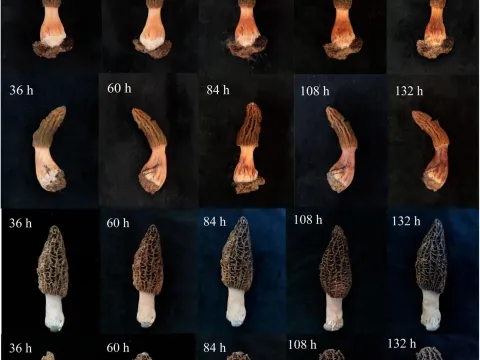
Morchella sextelata
Morchella sextelata
Morchella sextelata (six-spored morel) is a species of ascomycete fungi in the genus Morchella. It is crucial to note that this organism is not a plant pathogen and does not cause any plant diseases.
What the section contains
Morchella sextelata
Biologically, this fungus belongs to the saprotrophic group. It obtains nutrients by decomposing organic matter in the soil, wood debris, and leaf litter, without establishing parasitic relationships with the roots or tissues of living plants.
Mycological classification assigns it to the order Pezizales. A distinguishing feature of the species is the presence of six spores within the ascus, which is reflected in its specific name and confirmed by genetic research.
Unlike phytopathogens, Morchella sextelata lacks specialized organs for invading living plant tissues, such as haustoria or enzymatic systems designed to degrade the cell walls of living organisms.
Thus, this fungus poses no biological threat to garden, vegetable, or field crops and does not require inclusion in lists of organisms subject to phytosanitary control.
The development of the mycelium of this species is closely linked to high soil moisture and the presence of sufficient humus. It is most often found in areas with disturbed soil cover or in places where fires previously occurred.
Optimal conditions for fruiting occur in early spring with moderate soil and air temperatures. The fungus prefers well-drained areas where organic matter undergoes slow decomposition.
In the natural environment, Morchella sextelata is often found in symbiosis with soil microorganisms, although this process is mutualistic or neutral rather than parasitic.
The appearance of morels in fields or gardens indicates good soil quality, rich in humus, rather than the presence of an infectious background or signs of agroecosystem degradation.
Spore dispersal occurs mainly through wind or soil fauna, which is a natural cycle for most species of fungi inhabiting forest and forest-steppe zones.
Morchella sextelata does not cause damage to agricultural production. On the contrary, the presence of saprotrophic fungi in the soil helps accelerate the mineralization of organic residues, which indirectly improves soil fertility.
This species does not compete with crop plants for nutrients to an extent that would cause growth inhibition or a reduction in crop yields.
The absence of pathogenic activity means that no specific control measures, such as fungicide application or quarantine protocols, are applied to this fungal species.
Farmers and agronomists can consider the appearance of this fungus as an indicator of favorable ecological conditions that do not require human intervention.
In agronomic practice, cases of crop damage or root infection by this fungal species have not been recorded, as it lacks phytopathogenic properties.