
Morel
Morchella
In agronomy, it is critical to distinguish between actual plant pathogens and innocent soil-dwelling fungi. The morel (Morchella) is frequently confused with a disease, but it has absolutely no pathogenic impact on agricultural crops.
What the section contains
Morel
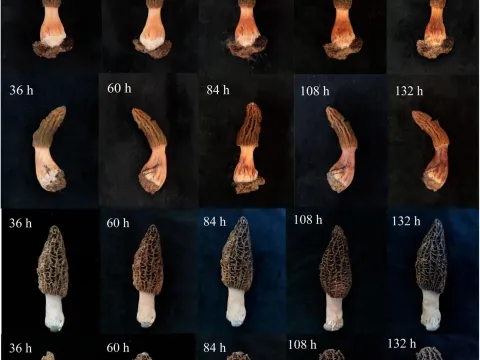
The fungus is characterized by a distinctive pitted, honeycombed cap. It grows exclusively on the soil surface, feeding on organic matter, and never infiltrates the internal tissues of plants or causes lesions on stems or leaves.
Farmers may notice morels in fields and assume they are a sign of disease. However, visual inspection will confirm that the surrounding crops show no symptoms of infection, such as chlorosis, necrosis, or structural deformation.
The absence of any mycelial coating on the plant surface is a key diagnostic feature. Unlike fungi that cause rusts, mildews, or blights, the morel does not rely on living plant tissue for its survival.
Presence of this fungus is simply an indicator of a rich, organic-heavy soil environment. It should not be treated as a symptom of a health issue in your agricultural landscape.
Scientifically, Morchella is classified as a saprotrophic fungus. It decomposes dead plant material, playing a constructive role in the soil food web, and is not a phytopathogen.
The fungus lacks the enzymes necessary to break down the cell walls of living plants. Its metabolic activities are strictly limited to the mineralization of detritus, which assists in recycling nutrients back into the soil profile.
In many ecosystems, morels function as beneficial organisms, facilitating the conversion of complex cellulose into simpler compounds that crops can eventually utilize. They are not plant enemies.
Misidentifying this fungus as a plant disease is a common mistake in agricultural reporting. As an editor at agronom.info, I emphasize that accurate biological classification is essential for efficient farm management.
Its life cycle is entirely independent of host plants in the pathogenic sense. It does not exert any pressure on the immune system of crops, nor does it thrive on living photosynthesizing organs.
Morels thrive in moist soil conditions, particularly in early spring when temperatures remain moderate. They are often found in soils with high levels of decomposing organic matter, such as old mulch or manure piles.
Their growth is often stimulated by specific moisture levels in the topsoil layer. Areas with high moisture retention and loose soil structure are the most common habitats for these fungi.
They are not restricted by light, but they often appear in sheltered areas where moisture can be preserved. This environment, while favorable for morels, is independent of the crop health status.
Soil texture is a vital factor. Morels prefer loose, porous soils that allow for gas exchange and consistent moisture distribution. Highly compacted fields are less suitable for their development.
Spores are dispersed by wind and water. Once they land on a substrate rich in decaying organic material, they germinate to form an extensive mycelium that can persist in the soil for years.
The harm caused by Morchella to agricultural crops is non-existent. It does not affect yield, crop quality, or the physiological vigor of the plants.
In fact, their contribution to soil health can be considered slightly positive. By speeding up the decomposition of crop residues, morels help in the early release of mineral nutrients required for plant growth.
There is no economic damage associated with this fungus. Attempts to eradicate them with fungicides are a waste of time and money, and may even harm beneficial soil microflora.
The fungus does not compete for resources like water or sunlight in a way that would hinder crop performance. It occupies a specialized ecological niche that does not intersect with the needs of the crop.
Farmers should focus their attention on legitimate threats such as bacteria, viruses, and parasitic fungi. Treating morels as a threat diverts resources away from genuine agronomic challenges.
Since the morel is not a pathogen, there are no control measures recommended. Any efforts to eradicate this fungus are unnecessary and inconsistent with sustainable agricultural practices.
To reduce their growth if they are physically obstructive, simple mechanical measures are sufficient. Tilling the soil or improving surface drainage will disrupt the fungal network and limit future appearances.
The focus of a professional agronomist should be on integrated pest management that targets real diseases. Neutral organisms like morels should be left undisturbed as part of a healthy soil ecosystem.
Monitoring programs should clearly exclude this organism from the list of controlled diseases to avoid confusion among staff and unnecessary chemical applications.
- Avoid unnecessary fungicide application for non-pathogenic fungi.
- Use balanced fertilization to maintain soil structure.
- Perform regular field monitoring to distinguish between helpful saprotrophs and harmful pathogens.