
Leucocortinarius
Leucocortinarius
It is essential to clarify that Leucocortinarius is not a plant pathogen or a disease-causing agent. It is a genus of gilled mushrooms belonging to the Tricholomataceae family.
What the section contains
Leucocortinarius
In the context of agronomy, these organisms are saprotrophic, meaning they derive nutrients from decaying organic matter rather than living plant hosts.
There is no evidence in botanical literature that links this genus to any damage in agricultural crops, orchards, or ornamental plants.
The confusion often arises because the mycelium of various forest fungi can be visible in the soil near the root zone, leading to misdiagnosis as root rot.
Consequently, Leucocortinarius should be classified as a beneficial or neutral soil component that contributes to the decomposition of organic materials.
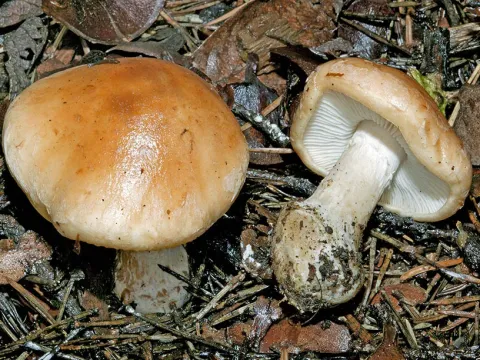
The primary sign of the presence of this fungus is the emergence of fruiting bodies, typically characterized by a brown cap and white lamellae.
These mushrooms usually appear in forested areas or gardens with rich, mulched soil, indicating high biological activity in the earth.
Contrary to parasitic pathogens, the roots of the plants located near these mushrooms show no signs of rot, browning, or structural failure.
The absence of lesions, wilting, or yellowing of the leaves in the nearby vegetation confirms that the fungus is not harming the plant.
Mycelial mats formed by these fungi are part of the soil microecosystem and do not penetrate or infect the vascular system of the host plants.
Growth conditions for Leucocortinarius are linked to the presence of specific substrates, such as leaf litter, needles, or high organic content in the soil.
These mushrooms thrive in cool, damp environments, with their activity peaking during the autumn months when moisture levels are sufficient.
Soil acidity also plays a role, as these fungi often prefer the slightly acidic conditions commonly found under coniferous trees.
Moderate temperatures ranging from +12 to +20 degrees Celsius are optimal for the development of their reproductive structures.
In cultivated fields, frequent irrigation and high mulch levels can occasionally facilitate their appearance, though they do not persist if conditions become drier.
There is no economic or agronomic harm associated with this fungus, as it does not pose a threat to plant health or yields.
Its role in the environment is strictly limited to the breakdown of organic residues, which potentially enhances soil fertility over time.
Since the fungus does not possess mechanisms for attacking live plant cells, it does not interfere with the nutrient uptake or growth of the crop.
No agricultural losses have ever been attributed to the Leucocortinarius genus, making it harmless to the agro-ecosystem.
As such, no preventive actions to eradicate this organism are necessary for maintaining crop safety.
Since Leucocortinarius is not a plant disease, there is no need for chemical control or fungicide application.
If the appearance of mushrooms is undesired for aesthetic reasons, simple mechanical removal of the fruiting bodies is sufficient.
Using fungicides to eliminate these organisms can be counterproductive as it may disrupt the beneficial soil microbiome necessary for healthy plant development.
Standard agronomic practices such as soil aeration and proper drainage are sufficient to manage the soil environment naturally.
- Maintain appropriate soil moisture levels
- Practice correct pruning and hygiene to reduce excess surface debris
- Ensure adequate ventilation in greenhouses
- Monitor soil pH levels as part of routine site management