
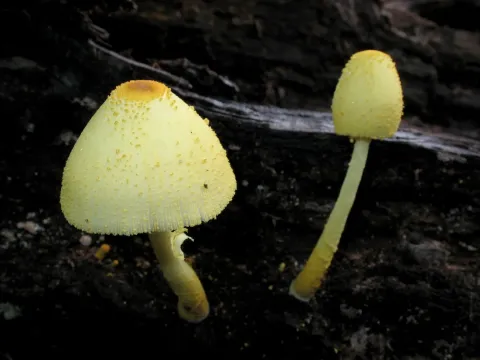
Leucocoprinus birnbaumii
Leucocoprinus birnbaumii
Leucocoprinus birnbaumii is a saprotrophic fungus belonging to the Agaricaceae family, commonly found in greenhouse environments and household potted plants.
What the section contains
Leucocoprinus birnbaumii
Unlike parasitic fungi that attack living tissues, this species acts as a decomposer, feeding on the organic matter present in potting soils and substrates.
The fungus is introduced into the environment primarily through spores that reside in commercially packaged potting mixes containing high levels of peat or wood debris.
It typically thrives in warm, humid tropical and subtropical climates, making indoor conditions ideal for its rapid colonisation.
The fungus develops a widespread subterranean mycelium network, which is the vegetative part of the organism responsible for nutrient absorption and reproduction.
The most distinctive sign of infestation is the emergence of bright yellow mushrooms, which often appear in clusters near the base of the plant.
Before the mushrooms emerge, white, web-like mycelial threads can be seen spreading across the surface or deep within the potting medium.
The cap of the fungus begins as a small, egg-shaped structure and eventually expands into a conical or convex shape with a distinct yellow color.
When the caps reach maturity, they release powdery, light-colored spores that can settle on nearby surfaces, leading to further spread in the greenhouse.
Owners may notice a damp, earthy smell emanating from the soil, which is a common indicator of high fungal activity within the pot.
The development of Leucocoprinus birnbaumii is strictly dependent on moisture levels, as the fungus requires a consistently damp substrate to flourish.
Warm temperatures ranging between 22 and 30 degrees Celsius significantly accelerate the growth rate of the mycelium and the maturation of fruit bodies.
Organic materials such as wood chips, peat moss, and bark are favorite food sources for this fungus, providing the necessary nutrients for its cycle.
Poor aeration in the potting soil combined with inadequate drainage creates a stagnant, oxygen-poor environment that the fungus exploits.
High relative humidity around the plant container further contributes to the proliferation of the fungus, preventing the surface of the soil from drying out properly.
Leucocoprinus birnbaumii is generally considered harmless to the health of the plant itself, as it does not consume living roots or foliage.
However, the denseness of the mycelial mat can lead to soil compaction, which restricts oxygen flow and causes stress to the plant's root system.
While the plant may not be directly killed by the fungus, the conditions required for the fungus to thrive are also conducive to the development of harmful root rots.
The mushrooms are toxic if ingested, posing a significant risk to curious pets and small children who might come into contact with them.
The visual presence of mushrooms often indicates that the soil is being overwatered, which is a leading cause of physiological decline in many indoor ornamental plants.
The most immediate control measure is to physically remove the yellow mushrooms as soon as they appear to prevent them from releasing more spores.
Improving the cultural practices, specifically letting the top layer of soil dry out between waterings, is the most effective way to suppress fungal growth.
If the infection is severe, replacing the top few centimeters of soil or repotting the plant with a fresh, sterile potting mix is highly recommended.
Fungicides can be applied to the soil to eliminate the mycelium, although keeping the soil dry is usually sufficient for long-term management.
- Ensure pots have adequate drainage holes.
- Avoid using soil mixes that appear to contain raw wood debris.
- Maintain proper air circulation around the plants to reduce humidity.