
Letrouitiaceae
Letrouitiaceae
Letrouitiaceae is a family of lichen-forming fungi that establish symbiotic relationships with algae to create stable lichen thalli.
What the section contains
Letrouitiaceae
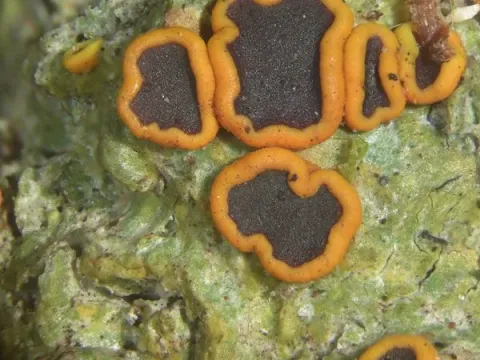
The most distinctive visual signs of their presence are the apothecia, which are fruiting bodies often characterized by vibrant orange or reddish pigments.
The thallus can appear as crustose or squamulose patches that adhere firmly to the bark of trees, showing various shades of gray, yellow, or green.
These organisms are typically found on the bark of older trees, appearing as patchy, sometimes grainy, crusts that spread slowly over the surface.
Unlike parasitic infections, these signs appear gradually and do not result in sudden wilting or rapid tissue necrosis of the host plant.
The core component of this object is a fungus belonging to the order Lecanorales, which is biologically obligate to its algal symbiont.
These fungi are not pathogens in the traditional agricultural sense because they do not extract nutrients from the tree's living vascular system.
They are classified as epiphytes, meaning they use the tree only as a substrate for growth, deriving moisture and nutrients from the atmosphere and bark dust.
The fungus provides the structural matrix, while the photobiont component provides carbohydrates produced through photosynthesis.
Reproduction is primarily achieved through fungal spores, which are released from the fruiting bodies and dispersed by wind or water splashes.
The growth of Letrouitiaceae is strictly governed by humidity, moderate temperatures, and the availability of stable surfaces on tree bark.
They thrive in environments with low to moderate light, often colonizing the shaded sides of trunks in forests or well-managed orchards.
Clean air is a critical environmental requirement, as many species in this family are sensitive to pollutants like sulfur dioxide.
The accumulation of debris and micro-moisture on bark crevices provides the necessary conditions for spore germination and colony establishment.
Prolonged wet seasons significantly accelerate the expansion of these colonies, allowing them to cover larger surface areas on the tree trunks.
Letrouitiaceae cause no direct physiological harm to the trees they inhabit, as they lack any mechanisms to penetrate or damage living wood cells.
However, dense coverage of lichen thalli can potentially obstruct the lenticels of the bark, which may slightly impede the gas exchange of the tree.
Their presence can be a symptom of a tree that is growing slowly or is in a state of senescence, where bark renewal is no longer frequent.
In high-density populations, they might harbor moisture for prolonged periods, which could indirectly favor the growth of other, truly pathogenic decay fungi.
From an agricultural management perspective, they are generally considered benign and do not necessitate aggressive eradication strategies.
Effective management focuses on promoting tree vigor rather than chemical eradication of the lichens themselves.
Regular maintenance, such as pruning dead branches and cleaning old, loose bark, is the most practical way to reduce their populations.
Applying lime wash to tree trunks is a traditional and effective method to alter the pH of the bark, making it inhospitable for lichen colonization.
Ensuring balanced fertilization and proper irrigation helps keep the tree bark healthy and resilient, discouraging massive colonization by epiphytes.
If necessary, iron sulfate solutions can be applied to physically remove and inhibit the regrowth of these organisms on specific ornamental trees.