
Description
Symptoms
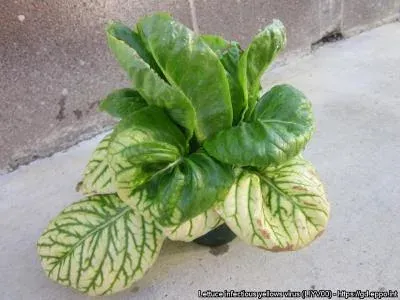
Symptoms typically begin on the older, outer leaves of the lettuce plant as interveinal chlorosis, which eventually spreads across the entire leaf tissue.
Leaves affected by the virus become thick, brittle, and leathery, often exhibiting a distinctive bright yellow to golden-orange discoloration.
Infected plants display significant stunting and reduced biomass, preventing the proper development of lettuce heads, which often remain loose and stunted.
Other susceptible crops like fodder beet and watermelon show similar signs of yellowing, leaf curling, and severe growth retardation when infected with the virus.
The progression of symptoms usually results in the plant failing to reach its harvest potential, rendering it entirely unsuitable for fresh market sales.
Pathogen
Lettuce infectious yellows virus (LIYV) is a plant pathogenic virus belonging to the genus Crinivirus within the family Closteroviridae.
This virus is phloem-limited, meaning it resides strictly within the transport tissues of the plant, disrupting the translocation of essential sugars and nutrients.
It is not mechanically transmissible via sap or seed; instead, it relies exclusively on insect vectors for transmission between host plants.
The primary vectors for LIYV are the greenhouse whitefly (Trialeurodes vaporariorum) and the silverleaf whitefly (Bemisia tabaci) in a semi-persistent manner.
The virus persists in various weed species, which act as crucial reservoirs during periods when primary commercial crops are not actively growing.
Conditions for development
The development and spread of Lettuce infectious yellows are intrinsically linked to the population dynamics of its whitefly vectors.
Warm and humid conditions favor the rapid reproduction and migration of whiteflies, which significantly increases the incidence of viral transmission in fields.
The proximity of infected wild weeds or adjacent agricultural plots serves as a continuous source of inoculum for newly established lettuce or other host crops.
Environmental stress, combined with vector pressure, often creates an environment where viral outbreaks can occur in rapid, successive waves.
Poor field sanitation, including the presence of host plant residues after harvest, allows the virus to survive and persist in the local agricultural landscape.
Why it matters
The primary damage caused by LIYV is a massive decrease in photosynthetic capacity, which directly translates to substantial yield losses across all infected crops.
Commercial losses are driven by the inability to sell affected crops due to their yellowed appearance, brittle texture, and overall poor physiological quality.
In fodder beet and watermelon, the virus severely limits the plant's ability to accumulate sugar and essential nutrients, impacting both biomass and internal product quality.
Infected plants are physiologically compromised, making them significantly more susceptible to secondary colonization by opportunistic pathogens and pests.
The systemic nature of the virus means that once a crop is heavily infested, there are no curative treatments, leading to complete field losses if left unmanaged.
Protection
Effective management focuses on aggressive control of whitefly populations through a structured integrated pest management (IPM) program involving insecticides.
Sanitation practices, specifically the removal of weed hosts around field margins, are essential to break the infection cycle of the virus.
Implementing physical barriers such as insect-proof netting in greenhouses can significantly reduce the risk of primary whitefly infestation.
Utilizing yellow sticky traps for monitoring allows growers to detect the arrival of vectors early and implement rapid protective measures before the virus spreads.
Crop rotation and spatial separation between different host crops help prevent the cross-contamination of fields and maintain lower overall viral pressure.
Pathogens and affected parts
Affects crops · 2
Discussion
No discussions yet — be the first.