
Description
Symptoms
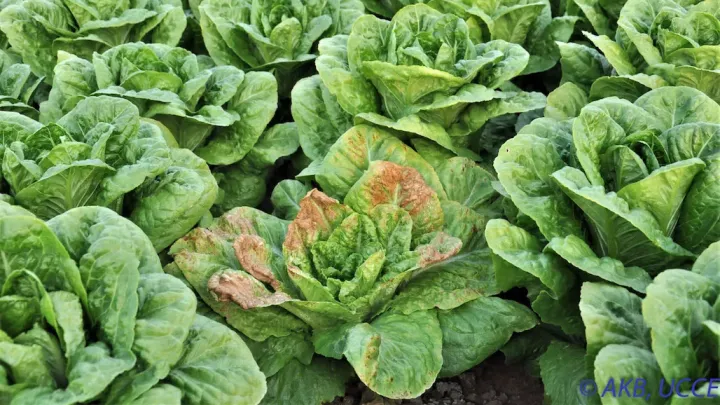
Initial symptoms include mild yellowing (chlorosis) of the youngest leaves, which eventually intensifies across the entire plant foliage.
The leaves often show downward curling, distortion, and the development of necrotic, brown-colored spots that tend to expand rapidly.
Plants infected at an early stage exhibit severe stunting, and the typical rosette architecture of the lettuce plant fails to develop properly.
In advanced stages of the infection, necrosis becomes widespread, leading to the collapse and death of entire leaves or the whole plant.
- Chlorotic yellowing of young leaves
- Leaf curling and deformation
- Development of necrotic spots
- Severe stunting and growth delay
- Necrosis and plant death
Pathogen
The causative agent of the disease is the Lettuce necrotic yellows virus (LNYV), classified within the genus Cytorhabdovirus, family Rhabdoviridae.
This virus primarily infects plants of the Asteraceae family, most notably lettuce, although it can affect a range of other host species.
The infection is systemic, meaning the virus moves through the phloem and spreads throughout the entire plant after the initial inoculation.
The virus is transmitted by the lettuce aphid (Hyperomyzus lactucae) in a circulative, persistent manner, meaning the aphid remains infectious after feeding.
Weed hosts serve as essential reservoirs for the virus, allowing it to persist in the environment even when no lettuce crop is present in the field.
Conditions for development
The spread of the disease is heavily dependent on the population dynamics of the lettuce aphid, which thrives in moderate, humid conditions.
Weather patterns that promote the rapid reproduction and migration of aphids from wild hosts to lettuce fields lead to disease outbreaks.
The presence of wild weeds in or near the cultivated field provides the initial source of infection for the aphid vectors.
Continuous cropping of susceptible host species without appropriate intervals increases the overall viral load in the specific area.
Infection is most common when young, susceptible plants are exposed to viruliferous aphids during periods of high insect activity.
Why it matters
Lettuce necrotic yellows causes significant economic damage to commercial lettuce production, often rendering the crop unmarketable.
The virus can also affect other crops, such as chickpeas, posing a risk to diverse agricultural systems where these hosts are rotated.
Beyond direct yield loss, growers incur additional expenses for pest control measures, removal of infected plants, and replanting efforts.
The inability to cure infected plants makes management difficult, forcing farmers to focus exclusively on prevention and vector control.
Significant infestations can lead to high percentages of crop loss, severely impacting the profitability and sustainability of the farm.
Protection
Integrated pest management focusing on the control of the lettuce aphid is the most effective approach to minimize viral transmission.
Sanitation practices, specifically the removal of weeds that act as virus reservoirs, are critical for maintaining healthy field conditions.
Maintaining a spatial buffer between older, potentially infected crops and newly planted areas helps prevent the migration of aphids.
Early identification of symptoms and the immediate rogueing of infected plants can slow down the secondary spread of the virus.
While resistant varieties are preferred, rigorous monitoring and chemical vector control remain the standard practices for managing this virus.
Pathogens and affected parts
Affects crops · 1
Discussion
No discussions yet — be the first.