
Description
Symptoms
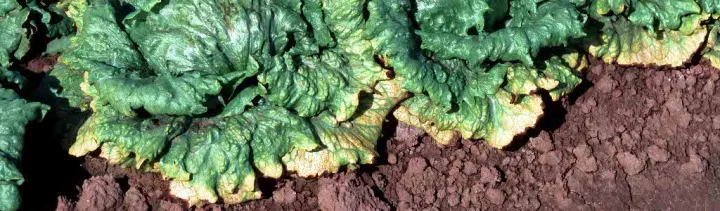
The primary symptom of Lettuce chlorosis is severe interveinal yellowing of the leaves. This chlorosis typically begins on the older, lower leaves and gradually progresses upward to younger foliage.
As the disease advances, the leaves lose their vibrant color and become brittle, thickened, and leathery. This alteration in tissue texture significantly degrades the plant's quality and marketability.
Affected lettuce plants exhibit stunted growth and fail to form proper, compact heads. The reduction in photosynthetic efficiency causes the plant to remain small and weak throughout the growing cycle.
Symptoms often appear in scattered patches across the field, reflecting the distribution patterns of the insect vectors that carry the virus from host to host.
Unlike some nutrient deficiencies that can be corrected with fertilization, the symptoms of Lettuce chlorosis persist regardless of soil amendments, serving as a key indicator of viral infection.
Pathogen
The causal agent is the Lettuce chlorosis virus (LCV), which belongs to the genus Crinivirus. It is a persistent, aphid-like virus that is primarily transmitted by whiteflies in a semi-persistent manner.
The greenhouse whitefly and the silverleaf whitefly are the primary vectors. The virus is acquired by the insect while feeding on infected plant sap and is subsequently transmitted to healthy hosts.
LCV is not mechanically transmissible, meaning it does not spread through pruning or handling tools. It depends entirely on the movement and feeding activities of whitefly populations.
The virus genome consists of two segments of single-stranded RNA, which allow it to persist within a diverse range of host plants, including various common weeds found in agricultural landscapes.
Biological studies suggest that the virus is restricted to the phloem of the plant, where it interferes with the translocation of sugars, leading to the characteristic chlorotic appearance of the leaves.
Conditions for development
Disease outbreaks are highly correlated with the presence and population density of whiteflies. Warm temperatures and high humidity create optimal conditions for rapid vector reproduction.
Protected cropping environments like greenhouses are particularly vulnerable because they provide a stable climate that supports whitefly survival and virus transmission throughout the year.
Infection cycles often start with whiteflies migrating from reservoir weed hosts into lettuce fields. The timing of this migration is critical, as young plants are most susceptible to the virus.
Poor ventilation and high planting density within greenhouses can exacerbate the spread, as these factors contribute to a localized microclimate that favors rapid insect colonization.
The virus remains active across a broad temperature range, typically between 20°C and 28°C, which perfectly aligns with the optimal growing conditions for most commercial lettuce varieties.
Why it matters
The economic impact of Lettuce chlorosis is severe, often resulting in the total loss of market-ready produce. Chlorotic leaves are unappealing to consumers, leading to high cull rates.
Growth suppression caused by the virus prevents the formation of marketable heads, significantly reducing total yield per acre for lettuce producers worldwide.
Infected plants exhibit compromised natural defenses, making them increasingly prone to secondary opportunistic pathogens such as soft rot bacteria and various soil-borne diseases.
Financial losses for growers include not only the loss of crop volume but also the high recurring costs of chemical insecticides and whitefly management strategies.
Large-scale outbreaks can cause long-term phytosanitary issues, forcing producers to fallow land or change crop rotations to break the virus cycle within the farm ecosystem.
Protection
Management centers on the integrated control of whitefly populations. Strategies involve a combination of biological control agents, such as parasitic wasps, and judicious use of systemic insecticides.
Sanitation is a vital component of control. Removing weeds that act as virus reservoirs in and around the farm perimeter is essential to stop the primary cycle of infection.
- Installation of insect-proof netting over greenhouse vents to block vector entry.
- Regular monitoring using yellow sticky traps to detect whitefly population spikes early.
- Strict adherence to sanitation protocols, including the disposal of crop debris after harvest.
- Spatial isolation of new lettuce plantings from older, potentially infected plots.
Chemical control must be timed precisely with the life cycle of the whitefly. It is crucial to rotate insecticide classes to prevent the development of resistance in whitefly populations.
In cases of confirmed infection, immediate roguing (removal) of symptomatic plants is recommended to reduce the inoculum load and protect the remaining healthy portion of the crop.
Pathogens and affected parts
Affects crops · 1
Discussion
No discussions yet — be the first.