
Letrouitia
Letrouitia
Letrouitia is a genus of crustose lichens belonging to the family Letrouitiaceae. Like all lichens, it is a symbiotic association between a fungus and algae or cyanobacteria.
What the section contains
Letrouitia
It is not a plant pathogen; it does not infect the vascular system or cause tissue decay. Instead, it is an epiphyte that uses tree bark only as a physical substrate.
The fungal component provides the structural body, known as the thallus, while the algal component provides nutrients through photosynthesis. This allows the organism to survive in nutrient-poor environments.
In an agricultural context, its presence is rarely a cause of plant disease but rather a symptom of environmental conditions and the overall vigor of the host plant.
The lichen does not derive nutrients from the tree sap, making it ecologically distinct from parasitic fungi or bacteria that destroy plant integrity.
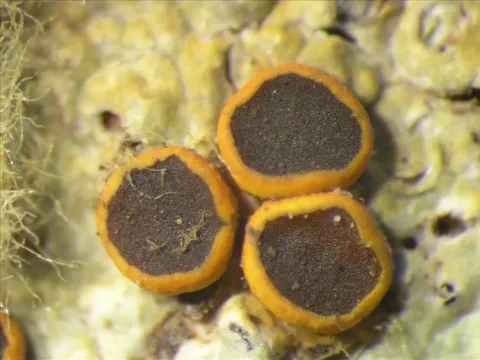
Letrouitia is characterized by a crust-like or sometimes slightly leafy thallus that adheres firmly to the bark. It is often vibrant in color, ranging from bright yellow to deep orange.
A key diagnostic feature is the presence of apothecia—small, disc-shaped or wart-like fruiting bodies that are usually reddish-orange and clearly visible against the thallus.
The thallus surface typically appears granular, scurfy, or smooth depending on the specific species and the humidity levels of the environment.
These lichens are most commonly found on the trunks and larger branches of mature or slow-growing trees, where the bark remains undisturbed for longer periods.
The growth pattern often creates patches of varying sizes, which may expand slowly over several years as the lichen colonizes more surface area.
Letrouitia growth is highly dependent on humidity and air quality. It thrives in environments with high moisture levels and a lack of atmospheric pollutants like sulfur dioxide.
Light availability is also a significant factor, as the algal component requires adequate illumination to perform photosynthesis, leading to higher density on the sun-facing sides of branches.
Stagnant air and poor tree maintenance are the primary environmental conditions that favor the rapid colonization of tree bark by these organisms.
The dispersal of the species occurs through the release of fungal spores, which are carried by wind to settle on suitable bark surfaces, where they eventually germinate.
Young, rapidly growing trees are rarely colonized because the expansion and shedding of bark make it difficult for the lichen to establish a permanent hold.
The harm caused by Letrouitia is mostly indirect. It does not actively damage the tree, but it can create micro-habitats for pests such as scale insects or mites.
In rare cases, extremely dense cover could theoretically impede bark gas exchange, though this is negligible compared to other biotic or abiotic stressors.
The main significance of Letrouitia is its role as a bioindicator. Its presence often indicates that a tree is growing slowly, lacks vigor, or is suffering from nutrient deficiency.
It is rarely a cause for alarm, but it encourages the grower to evaluate the general health of the orchard, specifically looking at soil fertility and pruning practices.
No direct chemical treatment is intended to "cure" the tree, as the focus should always be on supporting the health of the host tree itself.
Management strategies focus on modifying the growing environment and improving tree vitality to discourage lichen growth.
Physical removal using soft brushes is the safest way to clear branches, preventing the lichen from accumulating and harboring unwanted insects.
- Pruning the canopy to increase sunlight penetration and air circulation.
- Applying lime wash to trunks to raise pH and deter lichen spores.
- Implementing regular fertilization programs to boost tree growth rates.
- Removing dead wood and thinning overly dense branch structures.
Effective control is achieved by fostering a robust and fast-growing tree, as healthy trees naturally shed older bark, preventing colonization by lichens.