
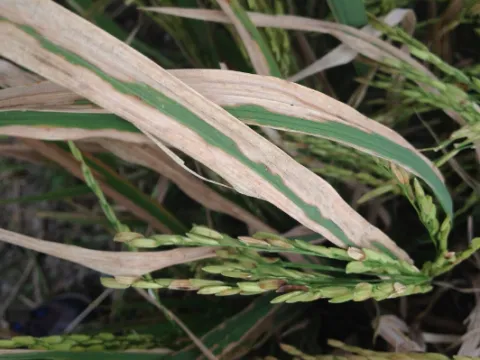
Rice leaf scald
Microdochium albescens
The causative agent of rice leaf scald is the fungus Microdochium albescens, formerly identified as Gerlachia oryzae. It is a significant pathogen affecting rice crops worldwide, causing substantial damage to foliage.
What the section contains
Rice leaf scald
The fungus is primarily seed-borne, but it also survives on infected crop debris left in the field. Conidia, the asexual spores, are dispersed by wind and water splashes, facilitating the spread of the infection during the growing season.
Upon landing on a leaf, the fungal spores germinate and penetrate the tissue, eventually leading to the colonization of the leaf surface. The pathogen relies on specific environmental conditions to complete its infection process.
While primarily known as a rice pathogen, Microdochium albescens has also been documented to infect sugar cane. This host range highlights the adaptability of the fungus within specific agricultural environments.
Understanding the biology of Microdochium albescens is critical for farmers, as the fungus exhibits high survival capabilities even in the absence of a primary host for short periods.
The primary symptom of rice leaf scald is the development of water-soaked lesions on the leaf blades. As the infection progresses, these lesions expand and change color to light brown or greyish-white.
A distinctive feature of this disease is the appearance of a dark margin surrounding the necrotic area. Lesions often elongate along the leaf veins, eventually leading to the blight of entire leaf segments.
Under humid conditions, the surface of the lesions may host a faint pinkish or white mycelial growth, which indicates the production of conidia. This mass spread of spores can lead to rapid disease escalation within a field.
The infection often begins from the tips or edges of the leaves and spreads downwards. Severely affected leaves eventually dry out and die, leading to premature senescence of the plant's foliage.
- Water-soaked, irregular lesions.
- Light brown necrotic patches with dark borders.
- Progressive wilting from leaf tips.
- Visible fungal sporulation in high humidity.
Rice leaf scald thrives in warm and humid environments. An optimal temperature range for the development of Microdochium albescens is between 22°C and 28°C, which accelerates the growth of the pathogen.
High relative humidity levels above 85% are essential for the germination of fungal spores. Frequent rainfall or heavy dew during the active tillering stage significantly promotes the spread of the disease.
Poor field management, such as overcrowding of plants, limits air circulation. This creates a humid microclimate within the crop canopy, providing the perfect conditions for the fungus to establish and propagate.
The application of high levels of nitrogen fertilizer can make rice plants more susceptible to infection by encouraging lush growth that is easily penetrable by the fungal hyphae.
Improper irrigation techniques, such as overhead watering during late hours, increase the duration of leaf wetness, thereby facilitating the infection process and the rapid spread of the fungus.
The economic impact of leaf scald is largely due to the reduction of photosynthetic capacity. By destroying leaf area, the disease limits the plant's ability to produce energy for growth and grain development.
Reduced photosynthesis leads to stunted plant growth and a significant decrease in grain yield. Infected plants often show poor tillering and reduced seed quality, including lower germination rates.
In cases of severe outbreaks, yield losses can reach 15–30%. The quality of the rice is compromised, as grains may become shriveled and possess lower milling properties, affecting the market value of the harvest.
The disease weakens the overall vitality of the rice crop, making it more susceptible to secondary infestations by other pests and pathogens, thus complicating the overall health management of the field.
Because the pathogen can be seed-borne, the harvest from infected fields often carries the disease to the next growing season, necessitating stricter post-harvest monitoring and treatment.
Integrated management begins with the use of resistant rice cultivars. Breeding programs focus on identifying and incorporating genes that provide natural resistance against Microdochium albescens.
Seed treatment with systemic fungicides is a crucial practice. Since the disease is seed-borne, ensuring that the initial planting material is free of the pathogen significantly reduces the risk of early-season outbreaks.
Good agricultural practices, such as optimizing plant spacing and improving drainage, are essential to reduce the humidity levels within the crop canopy. Managing crop residues is also vital to break the infection cycle.
During the growing season, if symptoms are detected, the timely application of fungicides is recommended. Monitoring programs should be in place to track disease development and guide chemical intervention.
Crop rotation is another effective strategy. By alternating rice with non-host crops, farmers can significantly reduce the pathogen population in the soil, leading to healthier future crops.