
Cotton leaf curl
Cotton leaf
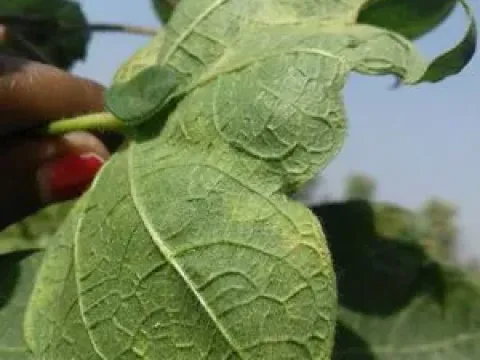
The characteristic sign of this disease is the severe curling and crinkling of leaves, which often twist into irregular shapes, significantly reducing their surface area.
What the section contains
Cotton leaf curl
Vein clearing is a primary diagnostic symptom, where the veins become pale and yellow, creating a distinctive network pattern on the underside of the leaves.
Infected plants show stunted growth, appearing much smaller than healthy counterparts, and often develop a bushy, abnormal appearance due to excessive shoot production.
The reproductive organs are severely affected, leading to the shedding of flower buds and the development of small, malformed, and non-viable cotton bolls.
Leaf texture becomes thickened and leathery, which further inhibits photosynthesis and severely weakens the physiological functions of the plant.
Cotton leaf curl disease is caused by the Cotton leaf curl virus (CLCuV), a member of the Begomovirus genus within the Geminiviridae family.
These viruses are circular, single-stranded DNA viruses that rely entirely on their insect vectors for transmission between host plants in the field.
The virus circulates within the phloem tissues of the cotton plant, where it interferes with the translocation of sugars and essential plant nutrients.
The virus is transmitted in a persistent, circulative manner by the whitefly species Bemisia tabaci, which acquires the virus while feeding on infected plants.
Genetic diversity of the viral strains often complicates management, as some strains may overcome the resistance previously developed in certain cotton cultivars.
The spread of the disease is highly correlated with the population density of the whitefly, which thrives in hot and dry weather conditions.
High temperatures accelerate the reproductive cycle of whiteflies, leading to rapid colonization of cotton fields during the growing season.
The presence of alternative host plants and weeds near cotton fields serves as a critical reservoir for the virus during the off-season.
Over-application of nitrogenous fertilizers can stimulate vegetative growth, making plants more succulent and attractive to whitefly infestations.
Regional environmental factors, such as wind patterns, contribute to the migration of viruliferous whiteflies from neighboring infected fields to healthy plantations.
Cotton leaf curl is a major limiting factor in cotton production, capable of causing substantial yield losses ranging from moderate to total crop failure.
The fiber quality is drastically reduced, leading to weaker, shorter, and less uniform fibers that are often unsuitable for high-quality textile manufacturing.
Economic damage is twofold: the reduction in total volume of harvest and the increased costs associated with frequent insecticide applications to manage vectors.
The disease stress compromises the plant's overall resilience, making it significantly more susceptible to other secondary infections and environmental stressors.
Persistent outbreaks force farmers to incur losses and often require the adoption of expensive resistant seed technologies to maintain farm viability.
The most sustainable strategy is the deployment of resistant cotton varieties that have been specifically bred to provide immunity or tolerance to CLCuV.
Integrated Pest Management (IPM) is crucial, focusing on monitoring and controlling whitefly populations through the judicious use of systemic insecticides.
Sanitation practices, including the removal of weeds and infected plant debris, are essential to break the infection cycle of the virus.
Adopting appropriate planting dates can help the crop bypass the peak migration periods of the whitefly vectors during the early stages of development.
- Use of certified, virus-free planting seeds.
- Implementation of crop rotation to reduce virus inoculum.
- Strategic use of biological control agents against whiteflies.