
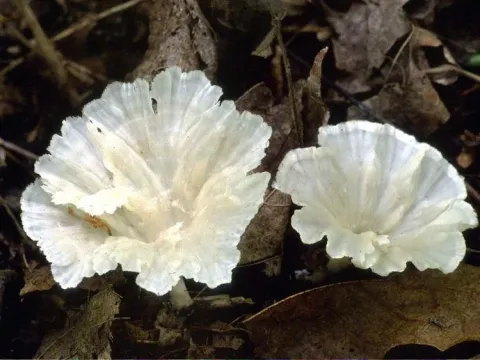
Cotylidia
Cotylidia
The visual signs of infection are the presence of distinct fruiting bodies on decaying plant debris or on the weakened parts of the host plants. These fruiting bodies typically appear as small, cup-shaped or funnel-shaped structures.
What the section contains
Cotylidia
The color of these structures is generally cream, yellowish, or light brown, and they often have a smooth or finely velvety texture. They tend to grow in clusters, making them visible near the plant crown or on soil-contacting debris.
Plant tissues affected by the fungus often show signs of softness, loss of turgor, and tissue necrosis. This is due to the secretion of specific enzymes by the pathogen, which break down plant cells.
Under high humidity conditions, a whitish or greyish mycelial mat may develop around the fruiting bodies, signaling active colonization of the plant tissue.
Over time, the affected areas become brittle or mushy, leading to stunted plant growth and, in severe cases, the death of the lower stem or roots.
The disease is caused by fungi of the genus Cotylidia (family Stereaceae, order Russulales). These are basidiomycete fungi that primarily exhibit saprotrophic behavior but can act as opportunistic parasites.
Reproduction occurs through spores that are dispersed by wind, water splashes, or insects. These spores germinate on plant surfaces when environmental conditions are suitable, allowing the mycelium to penetrate plant tissues.
The fungus is highly resilient, capable of surviving in the soil on plant residues for extended periods. This persistence ensures a recurring source of inoculum for subsequent growing seasons.
The life cycle involves the formation of basidiocarps, which serve as the primary reproductive phase. The fungus thrives by utilizing enzymes to degrade complex organic compounds present in the host plants.
Due to its high adaptability, the pathogen can infect a wide range of hosts, making it a significant challenge for diverse agricultural systems.
The development of Cotylidia is heavily driven by high moisture levels, specifically relative humidity above 85% and soil waterlogging. Persistent damp conditions are essential for the formation of fruiting bodies.
The optimal temperature range for mycelial growth is between +18°C and +24°C. These temperatures are most common in spring and autumn, which are the high-risk periods for primary infection.
Dense planting patterns and poor canopy ventilation create a stable, humid microclimate that significantly facilitates spore germination and mycelial spread.
Accumulation of non-decomposed plant residues in the soil provides an ideal nutrient source for the fungus. Heavy or poorly drained soil structures significantly increase the risk of disease outbreak.
Inadequate crop rotation, where susceptible species are grown in the same field too frequently, leads to an increased concentration of the pathogen in the soil.
The impact of Cotylidia is characterized by a reduction in overall crop yield and quality. Damage to the stem and vascular tissues limits water and nutrient transport, leading to wilting.
Root and stem colonization can lead to lodging in grain crops, which complicates mechanical harvesting and leads to direct harvest losses. Affected tissues are also prone to secondary microbial infections.
The pathogen produces metabolic toxins that suppress the plant's natural defense mechanisms and physiological processes, leaving it more vulnerable to other stresses.
In post-harvest scenarios, if contaminated soil remains on the produce, the fungus can initiate rapid rot, causing significant storage losses for vegetables and root crops.
Financial losses are substantial, stemming from yield reductions, the cost of fungicides, and the degradation of seed material quality.
The core management strategy is a robust crop rotation program with at least a 3-year gap between susceptible crops to deplete soil inoculum levels.
Proper soil management, including the deep incorporation of post-harvest residues, accelerates decomposition and reduces the pathogen's ability to survive in the soil.
- Treating seeds with appropriate fungicides to provide early-season protection.
- Selecting resistant or less susceptible plant varieties and hybrids.
- Maintaining optimal planting density to improve airflow and reduce micro-humidity.
- Strict weed control to eliminate alternative reservoirs for the fungus.
Improving field drainage is critical for reducing the risk of waterlogging, which is a key precursor to infection. Ensuring fields are level helps prevent water stagnation.
Regular monitoring of crop fields allows for the early detection of infection, enabling timely application of systemic or contact fungicides when necessary.