
Cotton rust
Puccinia cacabata
Description
Symptoms
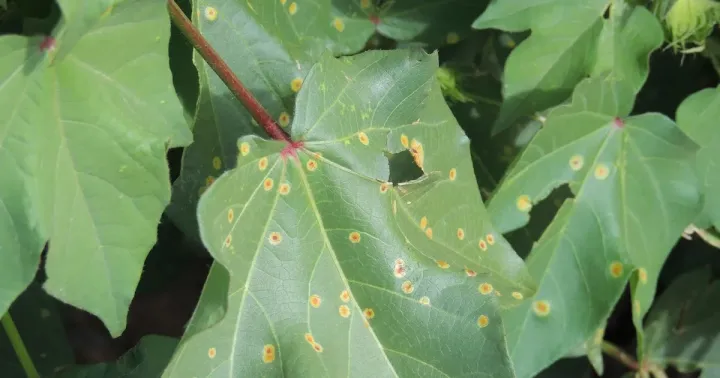
The initial visual signs of cotton rust infection appear as small chlorotic spots on the leaf surface. As the infection progresses, these areas develop into characteristic pustules filled with fungal spores.
The pustules typically exhibit a bright orange to rusty-brown color, which is the signature of this disease. Spore production most frequently occurs on the underside of the leaf, though severe infections can spread to petioles and bracts.
Infected leaves gradually lose their photosynthetic capacity. Heavily infested plants often undergo premature defoliation, which directly interferes with the development and maturation of cotton bolls.
In later stages of the disease, the pustules may coalesce into large necrotic zones. The affected plant tissue becomes brittle, and the overall plant health declines significantly due to disruptions in water balance and metabolic functions.
Diagnosis in the field is straightforward, especially during periods of high humidity when sporulation is intense and the rust-colored clusters become clearly visible to the naked eye.
Pathogen
The causal agent of cotton rust is a highly specialized fungal pathogen known as Puccinia cacabata. This rust fungus belongs to the Basidiomycota phylum and features a complex life cycle that involves alternating host plants.
The primary alternate hosts for this pathogen are various grass species within the Bouteloua genus. The fungus utilizes these grasses to complete specific spore-producing stages, which are vital for its survival and persistence in nature.
On cotton plants (Gossypium hirsutum and other species), the fungus manifests through uredinia and telia stages. The pathogen's life cycle is inextricably linked to climatic conditions that favor the long-distance dispersal of spores by wind.
The biology of Puccinia cacabata is well-adapted to the hot climates where cotton is typically grown. Its spores remain viable for significant periods, waiting for optimal humidity and temperature conditions to germinate on susceptible host tissue.
The genetic plasticity of this pathogen allows it to adapt to changing environments effectively, making it a persistent and dangerous threat for cotton producers who rely heavily on continuous cropping systems.
Conditions for development
The development of cotton rust is strictly dependent on moisture and air temperature. Periods of frequent rainfall or heavy morning dew create the perfect microenvironment necessary for urediniospore germination and penetration.
The temperature optimum for Puccinia cacabata falls within a moderately warm range. While extreme temperature fluctuations may temporarily slow the pathogen's growth, they do not eliminate the inoculum reservoir stored on plant debris.
The proximity of Bouteloua grasses to cotton fields is a critical factor in the outbreak of the disease. Wind currents carry spores from these reservoir hosts directly onto cotton leaves, initiating primary infection sites.
High canopy density in cotton fields traps moisture in the lower strata, creating an ideal incubator for the fungus. Under such conditions, spores penetrate the leaf stomata more rapidly, accelerating the overall disease cycle.
Poor ventilation within the crop canopy and excessive nitrogen fertilization can also trigger outbreaks, as lush, rapidly growing tissues are more susceptible to fungal colonization.
Why it matters
The economic harm caused by cotton rust is primarily reflected in significant reductions in fiber yield. Premature leaf loss leads to underdeveloped bolls and boll shedding, which drastically reduces the quality of the harvested fiber.
The disease negatively impacts the accumulation of sugars and essential nutrients within the plant. Due to impaired photosynthesis, the resulting cotton fibers become shorter and weaker, losing their commercial grade and value.
In cases of widespread infection, losses in raw cotton yield can reach critical levels, rendering cotton production economically unviable without robust chemical protection strategies.
Beyond direct damage to bolls, plants weakened by the disease become more vulnerable to secondary infections and opportunistic pests. This creates a cumulative physiological stress that drains the plant's resources during vital growth stages.
Financial losses stem not only from direct crop reduction but also from the increased costs of fungicide applications, which become mandatory to maintain profitability in years with high disease pressure.
Protection
The primary control strategy involves strict adherence to agronomic practices, such as the removal of reservoir weeds, particularly Bouteloua grasses, from field borders to minimize the initial inoculum load.
Utilizing resistant cotton varieties remains the most effective and environmentally sustainable protection strategy. Breeding programs continuously work to incorporate resistance genes into commercial cotton hybrids.
If necessary, fungicides based on copper or systemic active ingredients can be used. Applications should be timed precisely at the first signs of the disease to prevent widespread spore dissemination across the fields.
Crop rotation and spatial isolation of fields from the natural habitats of alternate hosts play a crucial role. Strategic land use planning helps to minimize the risks of wind-borne contamination.
Regular field monitoring and rapid diagnosis enable growers to react to threats in time. An integrated pest management system, combining cultural practices with chemical interventions, is essential to keep Puccinia cacabata under control.
Discussion
No discussions yet — be the first.