
Cotton leaf spot
Alternaria gossypii
Description
Symptoms
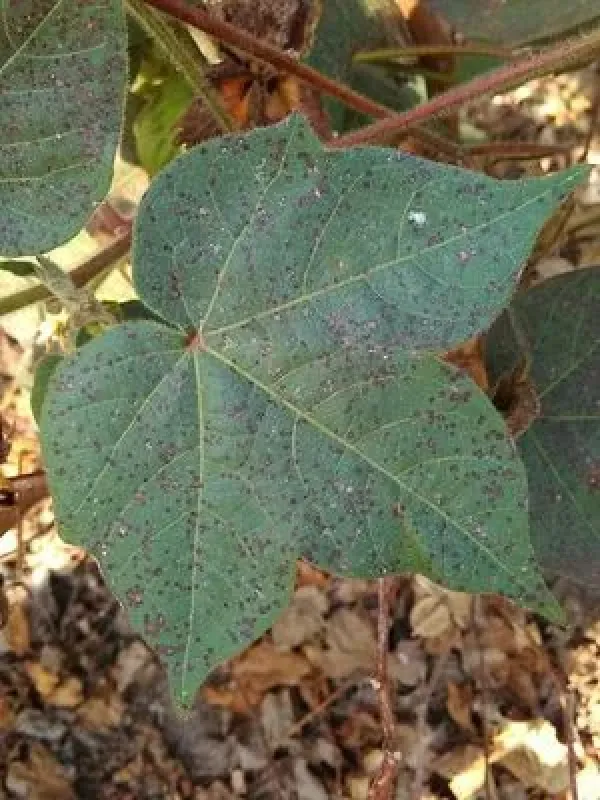
The initial symptoms appear as small, circular, reddish-brown spots on the leaves. As the disease progresses, these lesions expand and develop a distinct concentric ring pattern, which is a signature symptom.
The center of the spots may become light brown or tan, often surrounded by a dark margin. Under high humidity, the lesions show a velvety black or greyish growth, which is the sporulation of the fungus.
Stem lesions occur as elongated, dark-colored cankers that can girdle the stem, leading to stunting or complete collapse of the plant. Such damage is particularly devastating to young seedlings.
Boll infection results in dark, sunken lesions that penetrate the carpel walls. This often causes the boll to rot from the inside out, leading to fiber discoloration and loss of yield potential.
- Circular spots with concentric zoning on foliage.
- Velvety black fungal growth in the lesion center.
- Wilting and premature leaf abscission.
- Deterioration and rotting of cotton bolls.
Pathogen
The disease is caused by the fungus Alternaria gossypii, a pathogen that affects cotton plants globally. It is classified as an anamorphic fungus that survives in plant debris and soil.
The life cycle of the pathogen involves the production of conidia, which act as the primary inoculants. These spores are dispersed by wind, splashing rain, and mechanical contact during agricultural operations.
Upon landing on the host tissue, spores germinate and penetrate the epidermal layer. The fungus develops a branched mycelium that colonizes the plant cells, absorbing nutrients and causing localized tissue death.
Alternaria gossypii remains viable in soil and seed coats for long periods. This resilience makes it a persistent challenge for cotton producers, particularly in regions with continuous cropping systems.
Scientific research indicates that the pathogen can mutate and adapt to different environmental stressors, which necessitates ongoing monitoring and resistant variety development.
Conditions for development
High relative humidity and frequent rainfall are the most critical factors for the spread of Alternaria gossypii. Moist environments accelerate the germination of conidia on leaf surfaces.
The optimal temperature range for rapid infection and development is between 22°C and 28°C. These conditions lead to short latent periods, allowing the disease to reach epidemic levels quickly.
Dense planting patterns reduce airflow and increase canopy humidity, providing a favorable microclimate for the pathogen to thrive throughout the growing season.
Plants suffering from nutrient deficiencies, especially nitrogen and potassium, show increased susceptibility to the disease. Proper fertilization is essential for maintaining plant vigor.
Poor soil drainage and waterlogging can stress the plants, making them more prone to fungal colonization. Effective irrigation management is key to disease prevention.
Why it matters
The primary economic harm is the reduction in photosynthetic capacity due to massive defoliation. This severely limits the plant's ability to produce energy for boll development.
Boll rot significantly degrades the quality of the cotton fiber. Damaged fibers become brittle, lose their luster, and may require expensive processing to remove infected debris.
Seedlings infected at the early stage often die, leading to poor stand establishment. This results in reduced plant populations and necessitates costly replanting operations.
The disease cycle depletes the metabolic energy of the plant, making it more vulnerable to secondary infections and pest infestations, which further complicates crop management.
Cumulative yield losses can reach up to 30% in untreated fields during favorable weather conditions for the pathogen, significantly affecting farm profitability.
Protection
Integrated disease management starts with the use of certified, fungicide-treated seeds. This practice is crucial to prevent the introduction of the pathogen into new fields.
Crop rotation remains the most effective cultural practice. Rotating cotton with non-host crops like cereals or legumes disrupts the life cycle of the fungus in the soil.
Sanitation is paramount; plowing under all crop residues immediately after harvest minimizes the primary inoculum reservoir for the following season.
Implementing wide spacing and timely pruning can improve air circulation within the field canopy, keeping foliage drier and less conducive to infection.
Chemical control via foliar application of fungicides, such as copper-based compounds or triazoles, should be applied preventively during periods of high disease risk.
Discussion
No discussions yet — be the first.