
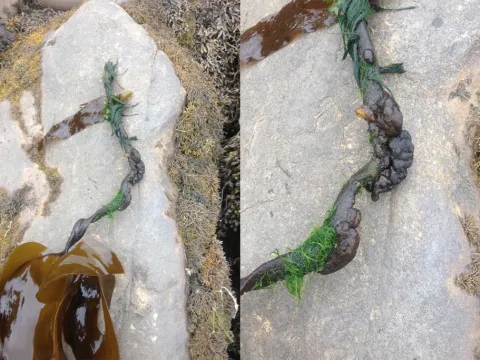
Laminariaceae
Laminariaceae
Laminariaceae is a family of large brown macroalgae, commonly known as kelp, and is not a plant disease. These organisms inhabit temperate and polar oceans, forming dense underwater forests that represent some of the most productive ecosystems on the planet.
What the section contains
Laminariaceae
The structure of a typical member of this family includes a holdfast, a stipe, and a large blade. Unlike land plants, they lack true roots, stems, and leaves, absorbing nutrients directly from the surrounding water through their entire surface.
The pigmentation of Laminariaceae is dominated by fucoxanthin, which allows them to efficiently harvest light in deep or turbid waters. This adaptation is crucial for their survival at depths where other photosynthetic organisms cannot persist.
In agriculture, the extracts from Laminariaceae are widely used as biostimulants. These products contain phytohormones, minerals, and complex carbohydrates that enhance crop resilience against abiotic stresses.
The lifecycle involves a distinct alternation of generations, switching between a macroscopic sporophyte phase and a microscopic gametophyte phase. Understanding this cycle is essential for large-scale aquaculture and sustainable harvesting.
Kelp species require nutrient-rich, cool water to thrive. They are particularly abundant in areas influenced by upwelling, where deep, cold, and nutrient-laden water reaches the surface.
Substrate stability is a primary environmental requirement. Laminariaceae require solid rock surfaces to anchor their holdfasts, making them absent from sandy or silty coastal environments.
Optimal light intensity is vital for the growth of young sporophytes. While they are adapted to low-light conditions, they still require a minimum threshold of solar radiation to sustain photosynthesis.
Water movement is essential for the distribution of nutrients and oxygen. High-energy coastal zones with constant wave action or tidal currents are typically preferred over stagnant waters.
Salinity levels must remain consistent with open ocean conditions. Significant fluctuations caused by freshwater runoff from river mouths can limit the distribution and health of kelp populations.