
Larch and willow rust
Melampsora laricis-pentandrae
Description
Symptoms
On larch, symptoms appear as bright orange-yellow aecia on the needles. Infected needles eventually turn yellow, curl, and drop prematurely from the branches.
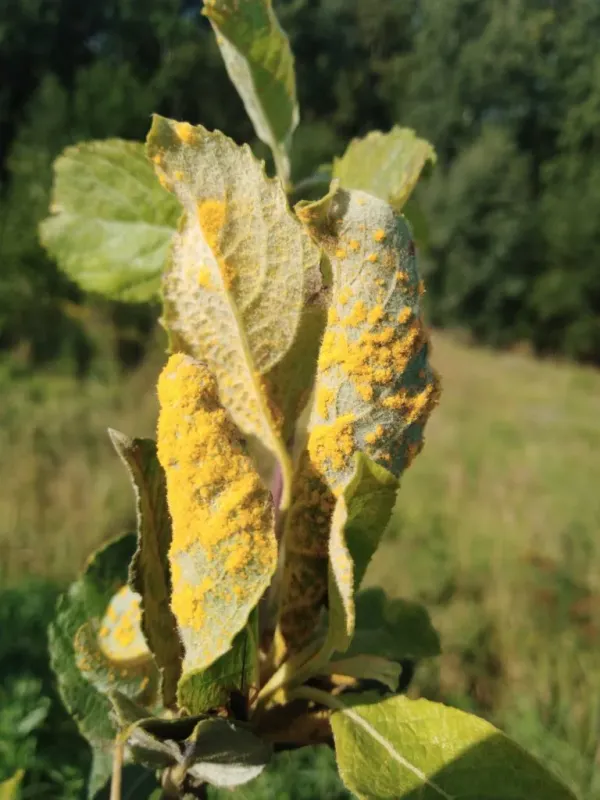
On willow leaves, the most striking sign is the appearance of bright orange or yellow pustules on the leaf undersides. These are rupturing epidermal cells releasing clouds of powdery spores.
As summer transitions to autumn, the pustules turn dark brown or black. These patches indicate the formation of telia, the stage where the fungus prepares for winter dormancy.
Heavy infections cause necrotic lesions across the foliage, often resulting in significant defoliation long before the natural leaf-fall season.
Affected trees often exhibit a sparse canopy, stunted twig growth, and a general appearance of stress or chlorosis.
Pathogen
The pathogen responsible for this disease is the heteroecious rust fungus Melampsora laricis-pentandrae. This fungus requires two different host species to complete its complex biological life cycle.
The fungus begins its cycle on larch needles in early spring, producing aeciospores. These spores are wind-dispersed and land on susceptible willow leaves, initiating the secondary stage of the infection.
Willow trees act as the primary host for the summer phase of the fungus. On the underside of willow leaves, the fungus develops uredinia, which produce masses of orange urediniospores that spread the disease rapidly.
Towards the end of the season, the fungus produces teliospores, appearing as dark, crusty spots on the leaves. These structures allow the pathogen to survive the winter in fallen plant debris.
As an obligate parasite, the fungus cannot survive without its host plants, making the removal of host proximity and plant debris essential for disease suppression.
Conditions for development
The development of larch and willow rust is highly dependent on environmental conditions, specifically high humidity and the presence of leaf surface moisture.
Frequent rainfall, mist, or heavy dew provide the necessary conditions for spore germination and infection establishment on both hosts.
Optimal temperatures for the fungus range between 15°C and 22°C. While warmth promotes fungal spread, excessive dry heat can temporarily suppress spore activity.
Densely planted areas or sites with poor airflow are particularly susceptible to severe outbreaks, as moisture remains trapped in the foliage canopy for longer periods.
The presence of both larch and willow in close proximity creates an ideal scenario for high infection pressure, as spores easily travel between the two host species.
Why it matters
The fungus severely impairs the tree's ability to perform photosynthesis by damaging the foliage, which is vital for energy production and storage.
Premature defoliation leads to a weakened state, leaving the trees vulnerable to winter injury and reducing their vigor for the following growing season.
In commercial nurseries, this disease can lead to significant economic loss due to stunted growth and the reduced quality or marketability of the plants.
Chronic annual infections significantly stress the trees, potentially opening the door for secondary opportunistic pests or other disease complexes.
The overall loss of foliage reduces the aesthetic value of the trees, which is a major concern in landscaping and public garden management.
Protection
The most effective strategy for managing this rust is physical separation, ensuring that larch and willow trees are not planted within close range of each other.
Sanitation is critical; all fallen leaves from under the trees must be raked and destroyed or deeply buried to eliminate the primary overwintering source of the fungus.
Pruning to improve air circulation within the canopy helps to create a drier microclimate, which significantly discourages the germination of fungal spores.
Fungicide applications, specifically those containing triazoles or copper, can be used to protect high-value trees when environmental conditions are conducive to infection.
- Apply protective copper sprays during the early spring bud-break phase.
- Monitor trees regularly during the summer for the first signs of orange pustules.
- Maintain healthy tree vigor through proper fertilization and watering schedules.
Discussion
No discussions yet — be the first.