
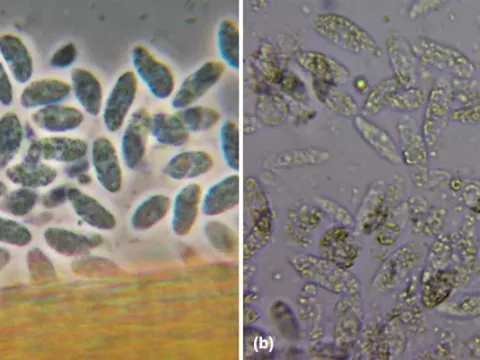
Labyrinthula terrestris
Labyrinthula terrestris
Labyrinthula terrestris is a unique microorganism classified under the group Labyrinthulomycetes. These organisms are known for their complex, net-like structures used to move across surfaces and penetrate host tissues.
What the section contains
Labyrinthula terrestris
Unlike most species in its genus, which are primarily marine, Labyrinthula terrestris has successfully colonized terrestrial environments, affecting various vascular plants.
The organism moves via ectoplasmic networks, allowing it to migrate between plant cells efficiently. It acts by secreting enzymes that break down cell walls, extracting nutrients from the host plant.
It can function as both a saprotroph, decomposing organic matter, and an opportunistic pathogen, switching to a parasitic mode when plant immunity is compromised or environmental conditions are optimal.
Biologically, it is highly adaptable, which makes it a persistent threat in agricultural and landscape settings. Research into its life cycle is ongoing to improve control methods.
Initial symptoms include chlorotic spots on leaves that rapidly progress to necrosis. The affected areas often turn brown or black as the tissue dies off.
A characteristic slime or film can often be observed on the affected areas, marking the presence of the pathogen's migratory colonies. This differentiates it from many standard fungal infections.
Affected plants often show signs of severe wilting that cannot be corrected by watering. This is due to the pathogen damaging the vascular system and cellular structure of the roots or stems.
In advanced stages, leaves may shed prematurely, and the overall plant vigor declines significantly. The lesions often expand in a pattern that reflects the movement of the pathogen through moisture films.
Unlike some bacterial diseases that produce a strong, foul odor, infections by Labyrinthula terrestris are typically odorless, which is a key diagnostic observation for agronomists.
High moisture levels are the most significant factor facilitating the spread of Labyrinthula terrestris. The organism requires a film of water to move effectively between plant surfaces.
The optimal temperature range for the pathogen's growth is between 18 and 25 degrees Celsius. Within this range, the microorganism can colonize new areas at an accelerated rate.
Poor ventilation and overcrowded planting conditions create a favorable microclimate, trapping humidity near the soil surface and promoting rapid disease development.
Physical injuries to the plant, whether caused by insects, tools, or weather events like hail, provide easy entry points for the pathogen to establish an infection.
The presence of decaying plant debris in the soil provides a steady food source for the pathogen, allowing it to maintain a high population density between cropping seasons.
The primary threat of Labyrinthula terrestris is its rapid transmission, which can destroy large areas of crops within a very short timeframe if conditions are conducive.
Plants affected by the pathogen suffer from reduced photosynthetic capacity and disrupted nutrient uptake, leading to significant yield loss or total plant mortality.
In turf management, the disease leads to unsightly patches that ruin the aesthetic quality of landscapes, often requiring expensive renovation or re-seeding of the affected areas.
The economic impact is compounded by the difficulty of early detection and the persistent nature of the organism in the soil, which complicates future land use.
Cross-contamination via contaminated tools, irrigation water, and even footwear can lead to rapid spread across an entire farm or greenhouse operation.
Preventative measures are the first line of defense. Ensuring only healthy, pathogen-free planting material is used is critical for avoiding initial infestation.
Crop rotation should be strictly implemented to break the life cycle of the pathogen, preventing it from establishing a permanent foothold in the soil of specific plots.
Improving drainage and reducing humidity through proper spacing and irrigation management are essential techniques for creating an environment hostile to the pathogen.
Rigorous sanitation protocols, including the disinfection of pruning tools and equipment, are necessary to prevent the mechanical transfer of the pathogen from infected areas.
Removal and proper disposal of symptomatic plant material, including roots, help to reduce the overall inoculum load in the field, mitigating the risk of further spread.